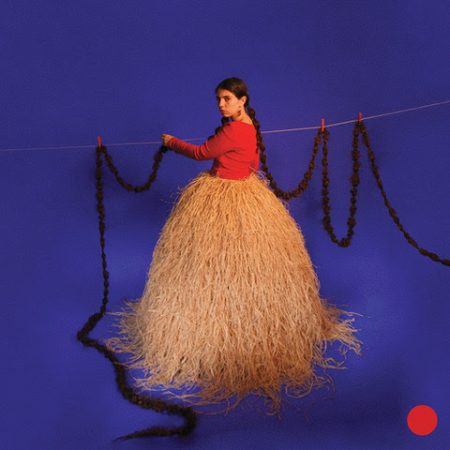
 The second album from Ana Lua Caiano magnificently captures the tension between tradition, the modern and futurism. It merges traditional Portuguese music, Caiano’s classical training, electronics and rhythmic intensity to create an effect that is feverish and spiritual on a record where bagpipes, flutes, adufe and bombo are juxtaposed with stunning choral arrangements, synthesisers and domestic machinery such as sewing machines. The record’s title ‘Devagar Que A Vida É Curta (Slowly as Life Is Short)’ comes from a phrase regularly used by Caiano’s grandfather. As a child, she understood it as an instruction to hurry whereas now she realises that it serves as a reminder to slow down and fully experience life.
The tracks that were released to offer a sneak preview of the album made it an eagerly anticipated release. The first single was the magnificent anti-drudgery of work anthem, ‘Uma Vida De Menos (A Lifetime Less)’ which over crashing piano, bagpipe and heavy beats sketches a lifetime of waiting for weekends and vacations, where “there are more men buried in work than in graves” and expresses a refusal to comply.
The second release, ‘Um Mais Um (One, another one)’ treats the theme of death playfully, its combination of rhythms, expressive singing, shrieks and occasional piano cascades creating a picture of life as a process and game with people lined up before and after each other, all awaiting their natural turn to die. Particularly pertinent are the lines, “With every step, our body sinks a little deeper / And brushes the dust from the grave.”
The most recent single, ‘Meu Amor, Fui (My Love, I’ve Left)’, addresses the idea of migration. It tells the story of someone who has left their home country and wants to return there but always finds a reason to postpone the journey. Read in translation, its litany of disaster can seem comical – “Just as I left the house, I broke my leg / Just as I left the neighbourhood, I lost my arm / From carrying the suitcases, I lost all my fingers / From running for the train, my lungs were gone” – picturing life as a slapstick tragedy. There is certainly an allegorical quality as she counts down the time to retirement, the rhythms gradually increasing in tempo until the final revelation of “don’t wait for I am already dead.”
The album’s musical themes reflect the conflict between frenzy and mindfulness with the 15 songs having an urgency and precision, none of them lasting much beyond three minutes while three of them are less than 30 seconds long. The record is bookended by two of these miniatures, ‘Procissão Dos Dias (Procession of Days)’ and ‘Procissão Dos Mortos (Procession of Death)’, full of tribal percussion and chanting that lend a ritualistic flavour. Initially, ‘Duas Mil Horas (Two Thousand Hours)’ continues in a rhythmic vein so that the sharp turn into classical piano and folk song comes as a surprise but introduces a trend with each track featuring dramatic twists of musical direction. The song also reflects a theme that is apparent throughout the album, that of loss and mortality, often dealt with in fantastical and melodramatic ways, on this occasion in the lines which translate as, “Oh, my love, only death can teach how to carve a coffin / And only disease can teach how to make a remedy.”
The electronics are particularly to the fore on the storming ‘Se A Cabeça Anda Manca (If the head is limping)’, all pulsing bass and percussion, multilayered vocals, broken up with bursts of grand piano. Its lyrics command to dance but not stumble, imploring to go slowly which makes it a song in which the words are in conflict with the music. Synths and Ely Janoville’s flute give ‘A Bala Nunca Fez Amigos / Du Sang Sur Les Mains (The Bullet Never Made Friends / Blood on their Hands)’ a Middle Eastern flavour to go with its brutal but surrealistic tale of hunting.
Caiano often displays a fascination with struggle and elemental forces, the incremental tussle for survival. This is especially prominent on ‘Come, Come, Cresce (Eat, Eat, Grow)’ with its brooding, repetitive rhythms and multilayered vocals. The images are stark as it portrays war, “macabre ideas of massacre, death and dread… few houses remain… the rest now turned dust, sketches, skeletons.”
An immaculate sense of pacing gives a thrilling quality to these tales of toil and travail so the images of a woman supporting a useless partner on ‘E Tu, Que Fazes? (And You, What Do You Do?)’ become ever more powerful in combination with thudding percussion and choral singing.
On ‘Hoje É Segunda (Today is Monday)’ which features Bandua, Edgar Valente and Tempura the Purple Boy, there is a macabre nursery rhyme feel to its procession through the days of the week, beginning and ending on Monday where “in the tomb / I die.” Producer and DJ Stereossauro guests on ‘Ai Digo Digo (Oh, I say and say)’, the level of woe has a comical tone, reaching its peak with the admission “when I water my plants, they still die of thirst… not even they can hear me” but the layered voices are genuinely stirring mixed with the sub-bass electronics. The final vocal track, ‘Vem Dançar (Come Dance)’, begins by suggesting miracles in its portrayal of Clara who can “disinfect the skull of problems and other pests” but she comes to a grisly end even though the music glitters and sparkles.
‘Devagar Que A Vida É Curta’ thoroughly lives up to expectations. It is magic realism given musical form. The vocals are dramatic and physically expressive, married to an innovative approach to rhythm and sound design. It is probably my favourite Glitterbeat release of 2026 which considering the quality of their ever-increasing catalogue is high praise indeed.
Ana Lua Caiano: ‘Devagar Que A Vida É Curta – Out 6 November 2026 (Glitterbeat)
Lua Caiano – Uma Vida A Menos (Official Video)

I was editor of the long-running fanzine, Plane Truth, and have subsequently written for a number of publications. While the zine was known for championing the most angular independent sounds, performing in recent years with a community samba percussion band helped to broaden my tastes so that in 2021 I am far more likely to be celebrating an eclectic mix of sounds and enthusing about Made Kuti, Anthony Joseph, Little Simz and the Soul Jazz Cuban compilations as well as Pom Poko and Richard Dawson.