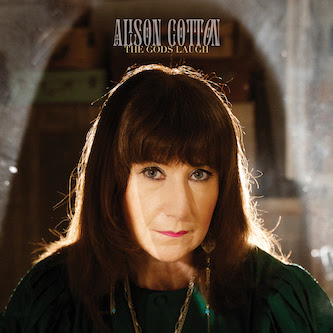
 There is an impressively austere quality to Alison Cotton’s music. Set within the self-imposed parameters of only using instrumentation that she owns, that policy initially saw her limited to viola, voice and Omnichord drone on her debut. In contrast, ‘The Gods Laugh’ has an expanded palette that also includes harmonium, piano, hammer dulcimer, treble recorder, bowed cymbal and percussion while partner / producer Mark Nicholas contributes bass, drums and synths. Both in its sound and inspiration, her catalogue has a seriousness of intent. This was exemplified by her 2024 album, ‘Engelchen’, which translates as ‘little angels’ and was inspired by the lives of Ida and Louise Cook who used their travels through Nazi-occupied Europe to see their favourite sopranos and conductors as a pretext to smuggle refugees and their possessions to safety.
Cotton’s new album has a more personal backstory, many of the ideas coming to her during the heightened period of creativity in 2024 when her father, who had encouraged her to take up the viola and gifted her the album’s title, was dying. The record maintains the sense of place within her music while delving into an examination of memory and the futility of human plans. Even though it is a brief folkish instrumental, ‘The Final Harvest’, is an important centrepiece. It is based on her father’s final visit to his allotment and presenting Cotton with a last haul of vegetables which she cooked and froze to preserve the memory for as long as possible. The stately but booming drums hint at the presentation of a feast. Remembering a place and activity that a deceased loved one enjoyed serves as a memorial. On a personal level, this really chimes as harvesting the final summer’s produce from my father’s allotment in the aftermath of his sudden death was a process that remains lodged in my mind representing a time when I felt particularly close to him.
Of the album’s nine tracks, three have lyrics. Among these is her adaptation of Victorian poet John Clare’s ‘I Am!’ Although it was the only song written before this period of loss, it makes a good thematic and musical fit with the rest of the album. Cotton was originally attracted to the poem’s song-like structure and hymnal quality. Her haunting voice hovers at the intersection of folk and choral music giving it a stern yet emotional pull as the narrator grapples with love, oblivion and God. Starting with minimal drone accompaniment to illustrate the isolation described, the song’s drama develops through the introduction of drums, harmonic viola crescendos which recall John Cale’s most unsettling contributions to the Velvet Underground and the cawing of crows.
‘The Night It Darkens All Around Me’ is semi-improvised over a drone base with lyrics delivered in a stream-of-consciousness style. It appears to be addressing death with its references to clocks chiming for one last time, distant cries but memories of joy and a return to the narrator’s childhood home. Musically the most conventional tune with piano to the fore is the exquisitely melancholy ‘Sprigs of Heather’ which sees her return to a narrative sketched in earlier releases. It is sung from the perspective of the lone survivor of a shipwreck surveying death, destruction and loss. On this song, Cotton’s voice is reminiscent of the late, lamented Trish Keenan of Broadcast which increases its impact and sense of sadness.
Among the three instrumentals which include the aforementioned ‘The Final Harvest’, there is the brief introductory track, ‘I Still Know You Are Calling My Name’ which serves as a memorial, conjuring images of a church service while the occasional percussion intrusions and creaking noises could almost be attempts at contact from the beyond. ‘Round of the Red Cape’ continues the nautical theme of ‘Sprigs of Heather’ and has the feel of a distressed journey.
‘The Gods Laugh’ includes a few tracks that feature wordless singing. One of these, ironically, is ‘What Were Those Words You Spoke to Me?’ where the choral vocals combine with drones and percussion to ominous effect. When chimes from the hammer dulcimer appear, the piece becomes even more chilling. It would make a superb soundtrack to an arthouse horror film. ‘A Storm in Morwenstow’ sees Cotton holding extended notes which match the elongated harmonium while viola scrapes later add a sense of urgency. Winding up proceedings, ‘The Gods Laugh While Others Make Plans’ has her voice in the background, almost like the distant laughter of gods at the conceit of mortals. There are bursts of percussion that mimic plans falling apart, while it is all contained within the structure of a melodic drone.
With ‘The Gods Laugh’, Cotton has created an atmospheric and deeply meditative record. While there can be a tendency among much experimental music to lean towards the calculating and somewhat distant, ultimately this is a richly emotional and engaging listen.
Alison Cotton: The Gods Laugh – Out 19 June 2026 (Glitterbeat / tak:til)

I was editor of the long-running fanzine, Plane Truth, and have subsequently written for a number of publications. While the zine was known for championing the most angular independent sounds, performing in recent years with a community samba percussion band helped to broaden my tastes so that in 2021 I am far more likely to be celebrating an eclectic mix of sounds and enthusing about Made Kuti, Anthony Joseph, Little Simz and the Soul Jazz Cuban compilations as well as Pom Poko and Richard Dawson.