 During the course of a music business career spanning over half a century, it is inevitable that it will not always run smoothly. After the not-quite overnight success of ‘This Town Ain’t Big Enough For Both of Us’ which appeared on their third album, the 1970s was a glorious decade for Sparks where they regularly switched styles from glam pop through big band swing, then disco/electro pop and onto more straight-forward rock with varying levels of commercial success but always retaining a high public profile.
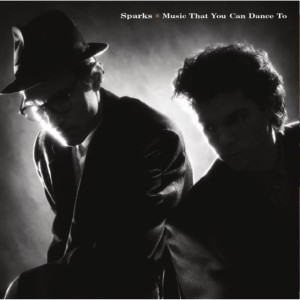
The 1980s was a different story. Even though they had clearly influenced the wave of synth duos that swept the British pop charts in the early part of decade, by the time of 1984’s ‘Pulling Rabbits Out of a Hat’, the attitude of many music fans mirrored my own in having moved on to newer, apparently fresher band. This, after all, was an era where the prevailing attitude was that musicians nearing the age of 40 were embarrassing dinosaurs, exemplified by The Rolling Stones. Such a perception was especially troubling for artists like the Mael brothers who constantly prided themselves on reinvention and never settling for cosy nostalgia. They were now fighting public indifference and record company impatience resulting in the title track of their 1986 album, ‘Music That You Can Dance To’, being a prickly response to a request for exactly that from a label executive. It is that very album which is now receiving a 40th anniversary deluxe reissue. If this were Hollywood, the album would have been a triumphant return to favour. In reality, in keeping with Ron and Russell’s preference for the less predictable narratives of arthouse cinema, it met with commercial and critical indifference at the time. The reissue offers an opportunity to reevaluate the album, especially as the band value it sufficiently to be including two numbers from it (the titular track and ‘Let’s Get Funky’) on their 2026 tour setlist.
What is immediately apparent from the opening title song is how Sparks were accommodating the big shiny 1980s production that at the time I was vehemently opposed to, preferring a scuzzier, noisier sound. At many stages of their career, they stood against prevailing trends so in that respect it was disappointing that they were now appearing to take a less risky approach. However, in hindsight it sounds fantastic. They were still all the traits that make Sparks instantly identifiable – Russell exploring his vocal range from slightly arch through staccato and falsetto delivery, Ron’s synths and lyrical humour describing music that you can dance to as having “no heavy message baby / just the perfect blending of sex and noise” – but given a contemporary polish. Of course, from today’s position it is easier to look back over their career and see how they have assimilated divergent trends while retaining a consistency of output.
Anyone who shares their cineaste preoccupations will see the title ‘Rosebud’ and instantly recognise it as the key word from ‘Citizen Kane’, the film that for a long period was viewed by critics as the greatest movie of all time. However, this song ends with the spoken word observation that while a single word in a movie can be used as a device to sum up a life, in messy real lives one word is never enough. The song employs a repertoire of 1980s sounds (clean bass, sirens, synth explosions and soulful, female backing vocals) to great effect.
While lyrically less remarkable, ‘Fingertips’ is notable for Russell’s falsetto, slap bass and the eminently danceable outlook that is at the album’s epicentre. Appropriately ‘Armies of the Night’, taken from the motion picture ‘Fright Night’, is more ominous but contains some archetypal idiosyncratic lyrics including “I’ve got a Sam and Dave revue playing in my heart tonight” and “it’s your patriotic duty to dance with me.”
‘The Scene’ is a high energy combination of domineering synths, heavy bass, big beats and explosions, It sketches a high-octane world where the dividing line between saints and sinners is open to question, luxury is referenced (champagne has appeared in many of their songs) and cheekily diss what were current musical trends (“there’ll be a world without extended mixes.”) Their fascination with consumerism continues on ‘Shopping Mall of Love’, a minimal electro track with a spoken word vocal from Ron in which he compares the abundance of a Beverly Hills mall with artworks like the Venus de Milo.
The up-tempo synth pop of ‘Modesty Plays’ sees them armed with multilayered Russell vocals and portraying a heroine who does not look like Genghis Khan or talk about her manicure but has a facility for getting things done. ‘Let’s Get Funky’ is the best example of their talent for creating mini movies in song form and Ron’s capacity for producing strikingly unusual imagery. To orchestral electro backing, they portray a silent femme fatale arriving on a Greyhound bus who “smelled like a small-town church but… looked like a queen.” As she moves in with the narrator, it quickly becomes apparent that the activities referred to in the title are more explicit than sitting listening to James Brown.
The album proper ends with ‘Change’ which flits between spoken word and operatic pop. There is a cartoon-like vivid imagery as the song’s narrator compares himself to a dog kicked out onto the street. The bridge section has him describing how Greece, Rome, the Wild West, vaudeville and paradise have all been and gone and there is also a dramatic, crashing instrumental section showing how well Sparks were suited to an epic 80s production.
Being a deluxe reissue, there are 17 bonus tracks, although these mainly consist of the very remixes they have decried on ‘The Scene’, including four variations on the title track. As someone who is interested predominantly in the song and narrative, I rarely deem them to be superior to the original version. Even though Sparks’ music does use repetition cleverly, there is nothing here to change my opinion. There are two additional songs that were not on the original album. ‘How To Survive’ is an unreleased song demo. A slightly melancholic synth pop song, its production sounds quite flat compared to everything else on the album. There is also an acoustic version of their greatest hit, ‘This Town Ain’t Big Enough For Both Of Us’, Russell sounding like a big band crooner while being accompanied solely by acoustic guitar. It is surprisingly effective.
While the bonus tracks are curiosities rather than versions that I am likely to revisit, this is a welcome reissue of an album that was unjustly overlooked originally. ‘Music That You Can Dance To’ is a significant part of Sparks’ catalogue and was better than at least 90% of what I was choosing to listen to in 1986.
Sparks: Music That You Can Dance To (40th Anniversary Deluxe Reissue) – Out 30 October 2026 (Curb Records)
– Music That You Can Dance To (Official Video)

I was editor of the long-running fanzine, Plane Truth, and have subsequently written for a number of publications. While the zine was known for championing the most angular independent sounds, performing in recent years with a community samba percussion band helped to broaden my tastes so that in 2021 I am far more likely to be celebrating an eclectic mix of sounds and enthusing about Made Kuti, Anthony Joseph, Little Simz and the Soul Jazz Cuban compilations as well as Pom Poko and Richard Dawson.