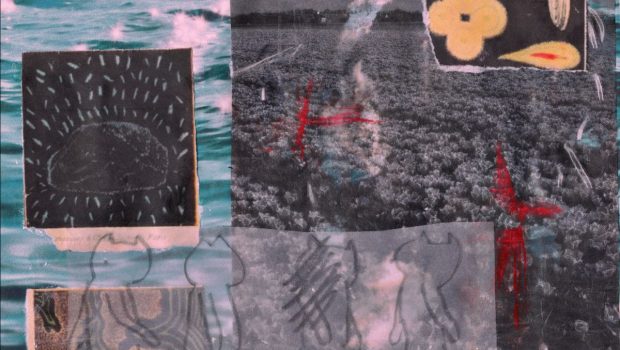
 The debut album from Lottie Brazier exists in its own distinct time zone. It is easy to imagine hearing John Peel playing it on the wintery early 80s night while I snuggled under blankets, transistor clasped to my ear. Whilst it could in no way be pinned as sounding like any one act from that era or even being remotely retro, it has the period’s spirit of adventure, experimentation and mystery that had been opened up by post-punk. Brazier’s voice gives her album an austere quality which is backed by synth heavy arrangements, those synths coming closest to matching the squelchy tone of early krautrock practitioners like Harmonia mixed with a splash of nascent Human League. As a musician, Brazier took early inspiration from the likes of Julian Cope, Bjork and Throwing Muses before a period in her early 20s writing music criticism for The Wire and The Quietus introduced her to ambient and instrumental composition. It is the thoughtful integration of these different approaches that gives ‘On Course But No-One There To Salute You’ its own distinct sound.
The record is undoubtedly front-loaded with some of its more pop-leaning and immediately accessible tunes, although they are still of a dark hue. Opening track ‘Look Outside’ has a frosty blast of keyboard accompanied by rhythm guitar and drum machine and starts her process of world building, launching the themes and ideas that pepper her songs. Its opening couplet, “you say you want sincerity / but would you give it back to me” sets up a questioning dialogue and in its references to the human need for travelling and being set free by writing, it focuses on the value of looking outwards. Ideas of creativity are signposted with ‘She Used To Paint’, an activity the song’s subject engaged in purely for herself. The lines “laying wreaths in foreign fields / poppies pushing the button watching the Queen / she’s finding it hard to readjust to the world she left” are oblique but suggestive of trauma. The synths are notable for the way they sketch a rhythmic pattern.
As soon as the drums crash in, ‘Take A Bow’ immediately seems a logical choice as a single. The synths create a highly danceable rhythm while the song features her talent for painting a striking image (“see his head / it’s screwed on backwards”) and reflects upon a time living in Brighton before moving to her current London home. Geography plays a huge role in the album with ‘Redshift’ taking images from Brazier’s long-distance running across the Suffolk countryside where she was brought up. In its references to sugar beet factories, crop circles and marshes alongside synths at their most ambient and menacing, it would make an ideal soundtrack to a dystopian film, apt as it was inspired by a Play For Today based on an Alan Garner science fiction novel of the same name. There is a deep sense of yearning within the song for a lifestyle part imagined, part lost.
Brazier’s biography indicates a fairly peripatetic early adulthood with spells living in Portugal and New York which is touched on in the song ‘American Cowboys’ with its search for meaning after graduation and escaping the cul-de-sac in which she was brought up but which only results in loneliness. She also reflects on whether the listener to a song needs to recognise themselves in the experience to identify with it. It makes for a thought-provoking track which with airy guitar backing puts the lyrics centre stage. In its atmosphere, it curiously recalls The Mekons’s ‘Ghosts of American Astronauts’ for reasons beyond its mention of the USA in its title. While the title of ‘Dust Clouds in Chicago’ places it in the States, it refers back to blighty and paints a repressive picture with the line “more walls in England than in Berlin.” There is a yearning for an imagined home in the clever follow-up, “where nostalgia lies, nostalgia lies”, a repetition that changes the words’ meaning and adds to the picture she creates of England’s awkward relationship with itself.
First single, ‘Ropes of Time’ is introspective pop whose outlook initially appears bleak in its chorus of “these are not your better days / and I am not your muse.” However, in its instruction to make no compromise and claim to have escaped the ropes of time, there is a resilience to its tale.
Elsewhere, the more minimal, ‘Working on a Sunday’ with strummed guitar and a distant weave of synths sees her reflecting on a music writer’s life. There is a sense of apartness in the lines “all the other writers / are marching to a different beat” and struggle from mention of “the crushing weight of hours.” In its use of almost gothic bass and drum machine, ‘Golden Matador (Talk To Her)’ marks a more abrupt and darker interlude. This grey mood is later emphasised with the guitar textures and slow, heavy drums of ‘Dogracer’ which opens with the lament “I should have left the house.”
Although it takes time for its charms to be fully apparent, the final track ‘Do You Want To Be Lonely’ ultimately emerges as the album’s finest moment. A melancholy story of internet fame and real-life anonymity, the banking of voices and synths as the song builds towards its conclusion being indicative of how well she uses Logic to create a mini symphony.
With ‘On Course But No-One There To Salute You’, Lottie Brazier has forged her own distinct path, one that has an often-difficult terrain and bleakly enveloping atmosphere, all of which deserves a lengthy line waiting to salute her.
Lottie Brazier: On Course But No-one There To Salute You – Out 20 November 2026 (Hand of Glory)
Brazier – Take a Bow (Official Video)

I was editor of the long-running fanzine, Plane Truth, and have subsequently written for a number of publications. While the zine was known for championing the most angular independent sounds, performing in recent years with a community samba percussion band helped to broaden my tastes so that in 2021 I am far more likely to be celebrating an eclectic mix of sounds and enthusing about Made Kuti, Anthony Joseph, Little Simz and the Soul Jazz Cuban compilations as well as Pom Poko and Richard Dawson.