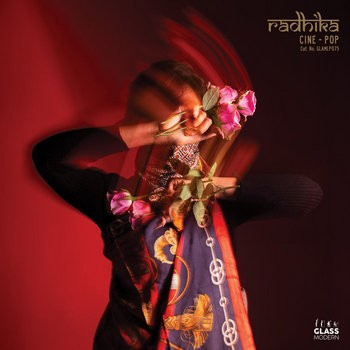
 Clocking in at 33.3 minutes, ‘Cine-Pop’ could be almost too conceptually perfect. Paying tribute to the speed at which a vinyl LP is played, it is ideal for listening to in one sitting. It does not overstay its welcome but has sufficient time to explore its musical enthusiasms. Fortunately, though, it is lacking in the appearance of contrivance having a natural flow instead. It is no surprise that Radhika Meera Dade is well-schooled in music history with her father being Sushil, the Future Pilot A.K.A. and one-time Soup Dragon. On her debut album, dream pop combines with goth pop, Glasgow indie and, in a nod to her Indian heritage, Bollywood to create a sumptuous collection of tunes and atmospheres. Amongst its eleven tracks are some sensational original pop songs, cover versions and wordless or instrumental pieces.
Falling into the sublime dream pop category, ‘Feline Bandits’ was inspired by watching a documentary about Vivienne Westwood, ‘Westwood: Punk, Icon, Activist’. Musically, it is like swallowing honey, naturally sweet owing to Radhika’s lush vocals, keyboards adding to the melodic overload and creating a sound that is defiantly widescreen while the lyrics celebrate love, life, sacrifice, asymmetry and the unconventional. Equally fantastic, the starting point for ‘Starry Eyes’ was looking through old black and white photographs with her grandmother who reflected on missing her mother. The key words in the song are “your disintegration is a cosmic lullaby”. Starting with gently strummed guitar and introducing spacy electronics, Radhika’s vocals are still dreamy but more impassioned in a tale of souls passing into the next realm
Maintaining a focus on the earth and wider cosmos, ‘Cocoa Butter Eyes’ is a love song to the universe and in its instrumental flourishes, mid-tempo pacing and big vocals recalls classic 1960s girl pop. Indicative of a precocious talent, the eco-anthem ‘Future Me’ was originally penned by a ten-year-old Radhika and in its concern for protecting the environment for future generations sits neatly alongside ‘Cocoa Butter Eyes’. With twirling flute lines and drums that recall The Jesus and Mary Chain’s ‘Just Like Honey’, it has a self-contained drama.
There are three interlinked wordless tracks that are variations on the same theme and melody. ‘Theme From R.A.D.H.I.K.A. (For David Lynch)’, kicks off the record with aplomb. Opening with sitar, it quickly blossoms into a melodic tour de force with soaring flute lines courtesy of Colin McGeogh and Radhika delivering joyfully wordless vocals. The ‘Theme From R.A.D.H.I.K/A (For Lalo and Laetitia)’ is dedicated to Argentinian film composer Lalo Schifrin and Stereolab’s Laetitia Sadier; with its organ swirls and motorik groove, it would easily sit alongside some of Stereolab’s poppiest moments. ‘Intermission Theme (Slight Return)’ makes use of harmonium, almost feeling like a dub version of the opening.
Proving that the album could have been called ‘Cineaste-Pop’, the Lynchian influence recurs on ‘Sleep’ which was triggered by watching ‘Blue Velvet’ for the first time. It blends trip hop beats with traditional Indian instrumentation and dream pop. Like Lynch, its surfaces are gleaming but there does not seem to be such disturbance hiding beneath them.
Oddly, the least successful of the three covers is a stripped back version of Strawberry Switchblade’s ‘Since Yesterday’, a bone fide Top Five chart hit from 1984. Perhaps the over-familiarity of the original makes it unimprovable but it is clearly a heartfelt tribute to musical heroes. A romantic traditional song recorded in her garden studio with sounds of nature embellished, ‘Tum Hi Ho’ serves as a recognition of her Indian heritage on a record that utilises such traditional instruments as tanpuras, dulcimers and harmoniums. ‘Cine-Pop’ is wrapped up with a big bow on top with Radhika’s sumptuous take on Yo La Tengo’s dreamy ‘Nowhere Near’. Here, she is able to take advantage of the family’s address book, being joined by a choir consisting of Gerard Love (ex-Teenage Fan Club) and Tracyanne Campbell (Camera Obscura).
The record ends with the sound of celluloid slipping off the film spool. The track-by-track description for the press ends posing the question, “But is there more?” Well, ‘Cine-Pop’ is an excellent debut indicative of a special talent to be enjoyed now but with the enticing prospect of what is to follow.
Radhika: Cine-Pop – Out 22 May 2026 (Glass Modern)

I was editor of the long-running fanzine, Plane Truth, and have subsequently written for a number of publications. While the zine was known for championing the most angular independent sounds, performing in recent years with a community samba percussion band helped to broaden my tastes so that in 2021 I am far more likely to be celebrating an eclectic mix of sounds and enthusing about Made Kuti, Anthony Joseph, Little Simz and the Soul Jazz Cuban compilations as well as Pom Poko and Richard Dawson.