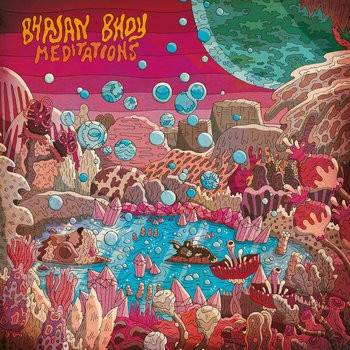
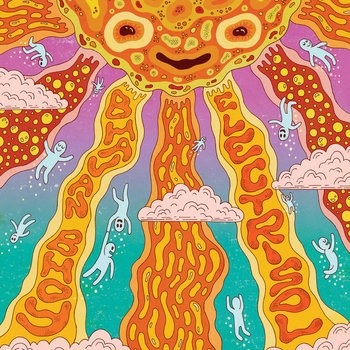
 The prize for most productive recording artists is hotting up. There are long standing contenders such as Robert Pollard of Guided By Voices and John Dwyer with his various OSEES iterations. They rarely seem to pause for breath with each season heralding a new album, all while maintaining a recognisable style and good level of quality control. A more recent candidate for this crown is Ajay Saggar. ‘Electrisol’ marks his third solo album of 2026 following on from ‘Live at Le Guess Who?’ and ‘Meditations’, all of which is a continuation of a busy 2020s.
What makes Saggar’s output more remarkable is that his releases are far from hastily assembled formulaic sets of chords. Instead, he offers deeply meditative and immersive soundscapes that incorporate psychedelic folk, dub science, kosmische electronics, shoegaze drift and field-recordings. Describing his response to listening to ‘Electrisol’ after its completion Saggar says, “It felt I was listening to an album that Brian Eno might have made had he recorded with Adrian Sherwood at the On-U-Sound studio!” As someone who grew up with the bands and music press of the 1980s, I am accustomed to the hyperbole and gobby attitude of acts with little to back it up. However, at its best, ‘Electrisol’ manages to justify these lofty claims and Saggar’s statement hints at delight at what he has created rather than arrogance.
Certainly, opening track ‘Africa Cup of Nations’ belongs amidst esteemed company with its serene passage through melodica, shoegaze guitar and dub echo while what distinguishes it from previous Bhajan Bhoy music is its rhythmic propulsion, the music twinkling with green and gold. Unlike his recent releases that have been stacked with lengthy ten-minute plus sonic investigations, the ten tracks on ‘Electrisol’ make their impact in a shorter time span, nothing lasting much longer than six minutes.
‘Om Gong’ would also take a place on the record’s highlights reel. It has the heaviest rhythms and could virtually be described as dub techno. With a similar mix of elements, ‘Desert Techno Club’ is an ideal meeting point for Harmonia and Augustus Pablo; it is an especially blissful combination and indicative of how well Saggar utilises space within his music.
‘Palidena’ is representative of a gently blissed out minimal guitar echo before the latter parts of the track are taken over by infectious recordings of laughter and then in the final brief section it gives way to harsher noise.
Often, the titles give an indication of what to expect from an individual track. As the album’s longest piece, ‘Mind Melt’ is unhurried in its mix of watery electronics with wavery guitar. It is easy to feel dreamy and dazed by the time it ends. ‘The Nightingale’s Lament’ does indeed include recordings of bird song wrapped around minimal guitar to create a piece that is, in the best sense, lazy and charming. A sample of Blixa Bargeld underpins the menacing and doomy ‘Buddha Bargeld’, the harshness of his German language mixing well with the dub exploration and background drilling.
A particularly personal track for Saggar, ‘Flicker Dreams’ uses a sample of Noor Jehan’s song ‘Umange Dil Ki Machli’ taken from the film Jugnu over which he has added snatches of dialogue from another movie, Mother India. For him, it is resonant with memories of growing up Kenya and being taken to see Indian films by his parents who would also play their favourite soundtrack LPs at home. Layering guitar, bass and synths over it, he has created something mesmerising and tingling with a positive nostalgia.
In its background crackles, ‘I Can See The Lights of Heaven’ cannot help but remind me of John Peel’s approving comment that life has surface noise. With its slowly circular guitars and bells, it would make a suitable accompaniment to drifting into another dimension. The record reaches its conclusion with ‘Phase G#’ on which it appears Saggar has raided his tool kit for hand percussion while bass disturbance happily coexists with spacey keyboards.
In common with his earlier releases, ‘Electrisol’ could easily function as background music for activity but that would be a waste. It really warrants immersion and concentrated listening, possibly with closed eyes but definitely open ears, so that it can take you on a voyage of discovery. With its imagination and coherence, it takes Bhajan Bhoy to the next level.
Bhajan Bhoy: Electrisol – Out 16 October 2026 (Cardinal Fuzz / Feeding Tube Records)

I was editor of the long-running fanzine, Plane Truth, and have subsequently written for a number of publications. While the zine was known for championing the most angular independent sounds, performing in recent years with a community samba percussion band helped to broaden my tastes so that in 2021 I am far more likely to be celebrating an eclectic mix of sounds and enthusing about Made Kuti, Anthony Joseph, Little Simz and the Soul Jazz Cuban compilations as well as Pom Poko and Richard Dawson.