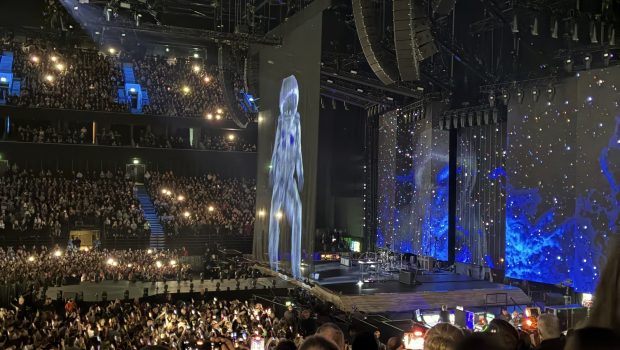
 How many bands can command a two-minute ovation five times over in a single show? Four siblings, one stage and a musical chemistry that feels almost telepathic. There is something particularly enchanting about watching a family make a spectacle of their togetherness. Yet, for all their collective brilliance, Infinity Song never lose sight of the individual voices that make them whole. Their performance is as much a celebration of musical heritage as it is of siblinghood; four distinct personalities, bound by a shared language of sound.
Opening the set with Fleetwood Mac’s ‘Dreams’ is nothing short of a bold choice. Taking on a track so deeply embedded in musical history is a considerable test of the quartet’s ability, but also an assertion of their confidence in their own artistry. The siblings stretch across the stage, allowing the weight of the original to settle around them. Momo Boyd plucks an acoustic guitar in flared sleeves, a famed Stevie Nicks staple, the fabric flourishing with each strum. The rendition is mellow and weightless, its dreamlike melodies floating seamlessly between speakers. As the performance draws to a close, the applause seems endless, the band standing patiently as they bask in the sound of their success. But the silence is short-lived. As the bass picks up, the familiar melodies take a grittier turn, replaced by harsher chords and a newfound urgency. Momo takes the vocal lead, her siblings gathering around her microphone to bolster her. What begins as an affectionate homage soon becomes something unmistakably theirs. The transformation is telling of what Infinity Song does best. They understand that musical legacy is not something to imitate, but something to inherit, reshape and redefine.
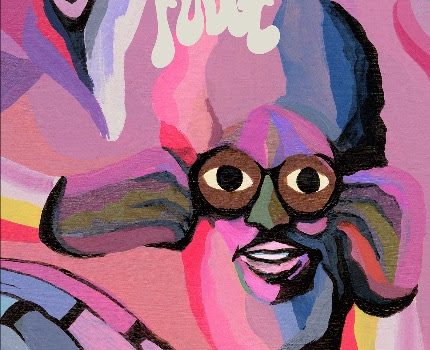
The siblings’ affinity with Fleetwood Mac extends far beyond their musical influences. Their latest release, INFINITY SONG, features the quartet photographed in billowy sleeves and flared trousers, an unmistakable nod to the stylistic vision of Rumours. Yet the similarities feel less like an exercise in nostalgia than a shared understanding of what makes a band endure. Like Fleetwood Mac, Infinity Song’s greatest asset lies in the dynamic between its members. For instance, the tension, tenderness and musical intuition that emerge when individual voices are given space to work together.
Abraham Boyd takes the lead on the next track, ‘No One Comes Close’, from the group’s 2023 album Metamorphosis. It is the only track on the album written solely by Abraham, which carries an added sense of intimacy. A starstruck love ballad, its lyrics are elegant and tender in their simplicity, almost adolescent in their earnestness. Abraham’s raw, gospel-rooted vulnerability recalls the soulful romanticism of 70s love songs, offering a refreshing counterpoint to modern R&B, which often trades open-ended heartache for detachment and numbness. There is no attempt here to disguise the desperation of wanting someone to stay. Instead, the emotional weight of the song seems to manifest physically on stage. His voice is lathered in a soulful richness, each note carrying an almost painful urgency. His siblings soften this depth with effortless harmonies. Even in a moment so distinctly his own, Abraham is never quite alone, and Infinity Song’s voices become a safety net beneath his vulnerability.
Perhaps the most admirable thing about Infinity Song is this exact dynamic. Their relationship as siblings lends an added dimension to their music, because their harmonies aren’t just a technical arrangement but more an extension of themselves. They each sing with the same vocal inflexions. Soulful, full-bodied, slightly nasally. But each has a folky, biting raspiness they use selectively to add an edgy grittiness to an otherwise earnest sound. Yet their voices never become indistinguishable. Rather, they understand how to complement one another, each bringing a different texture to the collective sound. Every run, inflexion and harmony feels intentional, as though they know exactly when to embellish and when to leave space. It is this balance of technical ability and restraint that distinguishes them from other artists. They do not need to compete for the spotlight but understand how to share it.
The quartet soon breaks into the TikTok-viral single ‘Hater’s Anthem’, a satirical take on ego, pride, jealousy, and the illusion of superiority when confronted with mediocrity. The track reignites a playful energy in the room, with the audience just as committed to maintaining momentum as the band. Momo strums tenderly on her acoustic while Abraham, Angel and Israel sing earnestly into their mics. The track is charming and heartfelt, sometimes cringey and artificial lyrically, but singular in creating a musical narrative that guides the song through its bogus façade. The siblings deliver their inner critics with such a refined levity that the song’s exaggerated bravado becomes part of the joke. Much like Abraham’s interpretation of ‘No One Comes Close’, the track needs not try too hard. It takes the crowd back into the classroom, as if crooned by a schoolyard nursery rhyme. Sickly, sometimes saccharine, it leaves the listener gluttonous for more. It is sweet as sugar, begging for second helpings.
The youngest of the Boyd siblings, Momo is afforded a moment to define herself beyond the collective, stepping into her own with ‘American Love Song’ from her solo album Miss Michigan. A folky ballad steeped in questions of identity, love and belonging, the song feels like an intimate introduction to an artist finding her own image. As her siblings and the band leave the stage, Momo is left alone with her guitar, illuminated beneath the spotlight. “I hope anybody in here who is on the fence about whether or not to bet on yourself, always bet on yourself,” she says. A seemingly simple sentiment, yet one that resonates far beyond the stage. Perhaps it is the universality of that fear, of taking the leap, of choosing yourself, or daring to be seen. This is what bridges the space between artist and listener.
Following her oldest brother’s solo performance of ‘Running Away’, Momo stuns in equal measure, though in an entirely different register. Tender fingerpicking and vintage, Americana-inspired melodies lend the performance an organic, almost haunting quality. There is a striking duality to her sound, both nostalgic and distinctly her own. She draws on the romanticism of traditional Americana while quietly reclaiming space within a genre whose history has so often overlooked black voices. There is a cinematic melancholy to her songwriting, though Momo brings a perspective unmistakably her own. Her melodies conjure images steeped in an American romanticism that feel both familiar and unsettled. A young starlet finding her wings, she makes the stage feel like a world of her own, intimate, spellbinding and entirely hers.
Infinity Song’s gospel roots are fundamental to their sound. From their beginnings singing in their hometown church in Detroit to commanding the stage, the quartet have carried that spiritual sensibility into an entirely different musical landscape. Their harmonies are singular, crisp and effortless, consistently occupying the sweet spot between gospel and soft rock. ‘Slow Burn’ closes the show, another fan favourite rich in gentle guitar melodies and stark lyricism. The siblings come together in a particularly touching display of affection, dancing, sharing mics. Israel walks over to his sister, wrapping an arm around her shoulders, while Angel leans into her brother. Their physical closeness becomes an extension of their relationship, a reminder that the harmony on stage is as much familial as it is musical.
“Let’s rock out as we walk out,” Abraham announces, sending the crowd into another eruption of applause. Momo and Israel take turns strumming their guitars with increasing fervour, abandoning the gentler melodies of ‘Slow Burn’ for something heavier and more abrasive. Abraham and Angel leave the stage, having had their moment, leaving the guitarists to face off in a musical stand-off that channels the unrestrained theatrics of 1970s rock. Their instruments answer to one another, trading increasingly explosive riffs. Momo exits, leaving Israel to claim the stage alone. He shreds his electric guitar with astonishing technicality; sharp chords and cascading scales collide with pounding percussion and bass, before a teasing moment of stillness gives way to one final flourish. Positioning his guitar behind his head, Israel strikingly continues his solo. One by one, the siblings have taken their turn in the spotlight, each demonstrating how they can command a stage alone. Yet it is their ability to pass the spotlight between them that makes their performance so compelling.
Infinity Song do not surrender to a singular sound, nor do they seem particularly interested in defining themselves by one. Their music is distinct, inimitable and unpredictable, moving effortlessly between gospel, soft rock, folk and the grand theatrics of Americana. But beneath this eclecticism lies something far more constant, the unspoken understanding between four siblings who know precisely when to lead, when to follow and when to lift one another up.