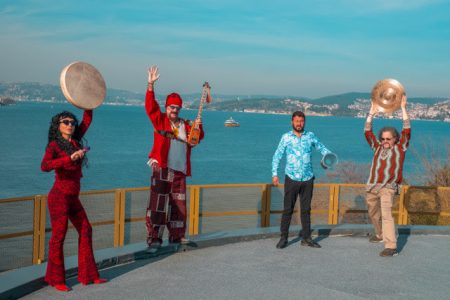
Photo by Mert Gider
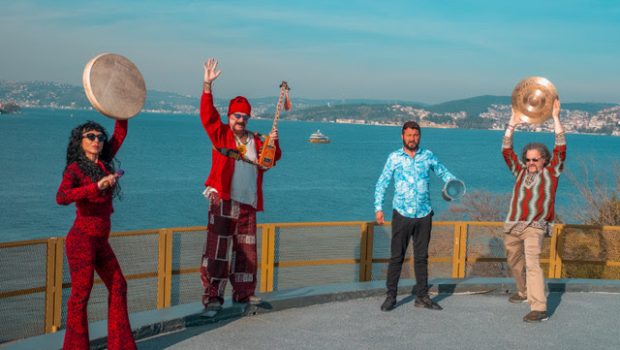
Celebrating their thirtieth anniversary, Baba Zula continue to seek out new approaches to music making that is marked by a refreshing unwillingness to repeat themselves. Describing themselves as sound warriors, their latest album, ‘XXX’, also reflects a willingness to confront environmental crisis and question the commodification of public life. Via email, Murat Ertel (electric saz, other stringed instruments, vocals, theremin, drums) and Levent Akmal (spoons, percussion, machines, toys) discussed the arts of collaboration and improvisation, the joy of life performance and how to remain positive amidst the wave of authoritarianism sweeping Europe and America. They started off answering some questions about the making ‘XXX’.
Can you tell us about the process of making the album? With each album being different from its predecessors, do you go in with a clearly defined idea of how it is going to sound?
Murat:
As we wanted to make a 30th year anniversary album, we were looking for a sound and we came up with the idea of going for the early days of Baba Zula and on these days we had a acoustic double bass played by an American friend of ours called William Mcbeath. So that was our first move, then we wanted to add something new, something that we hadn’t done and that was to work with a keyboard player. I used to play some synthesizer on some Baba Zula songs, but we didn’t work with a proper keyboard player before, so the addition of these two guest musicians was very crucial, in forming the sound of the album. And then we decided that we would use the power of the number 30 for the album and we made the album 30 minutes 30 seconds and 30 ms long. Also using Crossfade was very important. We loved this technique especially used in the albums of 1960s and we hadn’t done this before. We decided that our 30th anniversary album was not going to be consisting of greatest hits, but fresh new songs with a fresh new approach.
Each album has a different theme. Which comes first, the theme or the sound?
Murat:
I think the sound comes first, at least it did for the previous album called The Streets of İstanbul. It was the sounds of İstanbul that came to our minds, but thinking about this new one is blurry. I don’t remember. Maybe it was the name of the album that came first? I cannot answer this question. Sometimes an album and some themes are coming and going, and sounds are coming and going too. I think I cannot tell which part comes first. They are inside each other. But the inspiration comes first and this inspiration can be some sound or some stories or some themes but usually we do it first and then find a title.
Your music has a rhythmic and hypnotic quality. Does improvisation play a big part in your creating the music?
Murat:
I think that without improvisation, doing music—or at least composing music—is not really possible. Without improvisation, you can only repeat something, and that kind of repetition can become boring. We try to remember our improvisations and then add more conversations on top of them. We don’t play the same arrangement or the same song exactly as it was recorded, but I see many people trying to repeat a recording exactly as it is, and I find that kind of boring.I really think people should try to get close to the essence of the music that was recorded. They should get close to the lyrics of the song as they were recorded, but if they can improvise more, I think it will be much better. Of course, this is a very hard thing to do. Even we sometimes stick to the lyrics we recorded and to some of the music and arrangements we recorded, but we always take our chances to create a musical conversation around it.
You are known for collaborating with a stellar cast of artists including the Mad Professor, Jaki Liebezeit and Warren Ellis so I would like to ask a few questions about these collaborations. How did the collaborations come about? What lessons have you learned from these collaborations? In an ideal world, who else would you like to work with in future?
Murat:
With Mad Professor, it was an idea from our record label, Doublemoon. We brought in the mixes, and they said, “This has become a very dubby album, so let’s find a very good dub producer that you like, and we will organize it and make it work.” Then we started to think, “Who should we work with?” We wanted King Tubby, Lee Perry, Scientist, or Mad Professor. Those were our choices. But Tubby was dead, and we were afraid to work with Perry because he was, you know, a wild guy. Then we came down to Scientist and Mad Professor, and we were thinking about which one to work with. Then we listened to the album that Mad Professor did with Massive Attack, and we chose Mad Professor. He was, and he is, a great guy, and we continued to work together with him around the world. We learned so much from him. For instance, we were mastering our album Psyche Belly Dance Music, and we were using DAT tapes in those days. I watched the VU meters, and they were not moving; they were stuck all red. I asked the Professor, “Is everything all right? Because the meters are completely red.” The Professor looked at me and said, “Do you hear anything wrong?” I said, “No,” and he said, “Please don’t judge music with your eyes.” That was a great lesson for me. Then, with Jaki Liebezeit, it was a fantastic union. We met him in Cologne and started playing with him, and he had a great knowledge of Turkish culture and Turkish music. He was a fantastic drummer; he could play Turkish rhythms in odd meters inside and out. I think he was one of the greatest drummers who ever lived, and he was a very mean guy, you know. We saw him breaking down many great musicians and treating them really badly, but he never did it to us. He had great respect for our music and for us, too, and we learned so many things from him. We learned harmony, scales, and rhythm theory from him. He was really our greatest teacher in this life when it came to music, I can say. As for Warren Ellis, he came to a Baba Zula concert and loved it, and we also met him backstage at a Nick Cave concert in Berlin. We made a musical collaboration with him, but this was not for Baba Zula; it was a solo recording for Esma Ertel that has not yet been released. He’s also a great musician, and we want to continue these collaborations. We also played with the guitar player Fred Frith, and on his website he wrote about our gig that it was one of the best concerts he had ever played. We were really surprised and honoured because he plays with such great musicians. We really want to continue playing with all these musicians again.
You have a European tour lined up this Autumn. What can audiences expect from the shows?
Levent
Yes, we’ll have a 21-concert European tour in October. We’ll be on the road for almost a month, and while these journeys are tiring, they’re also enjoyable. We’re all very excited; we love touring because each time we encounter a different city, a different country, different stages, and different audiences. Every city and every concert is important to us. Each concert is actually different; some people who come to one concert then watch another tell us how different the performances were, even though we play the same songs. This is because we incorporate improvisations into our concerts, and the songs we play aren’t exactly the same as the songs on the album; there are differences in both duration and content, so each concert is full of surprises. Also, each concert is like a special occasion because we come from a different culture, and people come to our concerts with certain prototypes in their minds, and they are quite surprised after we start playing. But after the second or third song, this surprise passes, and a sense of togetherness develops; mutual energy flows and uplifts – these are the emotions the audience will feel at our concerts. Finally, they understand that we are all one, that we are all the same kind of Homo sapiens, and that we feel the same emotions. This reveals that the countries of the world, which are being divided by borders, are actually all the same and should unite in a single essence. We are very happy that we have achieved this through our music. We look forward to seeing you at one of our concerts.
Are there any plans to add any shows in the United Kingdom?
Levent:
Yes, we really want to play in England and we love the stage and the audience there. We came to England many times before the pandemic and had wonderful concerts and memories, but conditions have changed since the pandemic. We also have visa problems, especially with UK entrance, where they cross-examine us . Because of this questioning, we need to obtain a certain class of visa, which is difficult and expensive, so the organizers have to pay for it, but they don’t want to. Also, because Istanbul is geographically far from Europe, plane tickets are very expensive, so the organizers are struggling to pay for them as well. Therefore, we will not be able to play in England on this tour.
As a politically engaged band, what challenges have you faced remaining positive when Türkiye’s authoritarian leader Recep Tayyip Erdoğan has been in power for so long?
Levent:
Unfortunately, authoritarian leadership is not a problem unique to Türkiye; authoritarianism is increasingly taking precedence over democracy worldwide, particularly in European countries. For example, in Germany, the far-right party has been steadily increasing its vote share in recent elections, even reaching 42% in the state of Saxony – a truly saddening situation. We in Turkey have been experiencing these unpleasant situations for years and have gained experience in this regard. As the laws of nature dictate, no entity or situation can last forever, therefore, this authoritarian situation in our country will end in the near future because it has been going on for quite a long time. Furthermore, more than 50% of the population in our country opposes this authoritarian regime. Abroad, it is thought that this authoritarian regime is strong and that the people approve of it, which is completely wrong. Despite the authoritarian regime in our country illegally imprisoning these dissidents, the people continue to resist. We, too, are doing our best within this opposition through our music and art. Ultimately, we will win.
What are BaBa ZuLa’s future plans?
Murat:
I think being able to perform live is very precious. We want to be able to play together and survive as a band, which is also very rare and precious. The conditions on Earth are getting harsher, and we really want to continue playing. We want to continue playing without sacrificing our ideals and our dreams. We see so many musicians sacrificing their dreams. Maybe they dream of getting rich, becoming famous, or being successful, but fewer musicians are trying to realize their musical dreams. I cannot understand people who make music only by playing other people’s music. Why are they playing this? Don’t they have anything to say or anything to play from within? Don’t they have music in their hearts and souls? Why do they do this? They should stop and tell us, sing to us, what they have in their souls and bodies. I am interested in this kind of music, and we want to heal, we want to fight against injustice and oppressors, we want to be on the side of animals and plants and justice, and we want to continue doing this. We want to change everything into something positive and into something that we believe in. This is a very important thing to do. We want to continue this. We are sound warriors.
‘XXX’ is released on 25 September via Glitterbeat and is a feast for the ears (see review link below)

I was editor of the long-running fanzine, Plane Truth, and have subsequently written for a number of publications. While the zine was known for championing the most angular independent sounds, performing in recent years with a community samba percussion band helped to broaden my tastes so that in 2021 I am far more likely to be celebrating an eclectic mix of sounds and enthusing about Made Kuti, Anthony Joseph, Little Simz and the Soul Jazz Cuban compilations as well as Pom Poko and Richard Dawson.