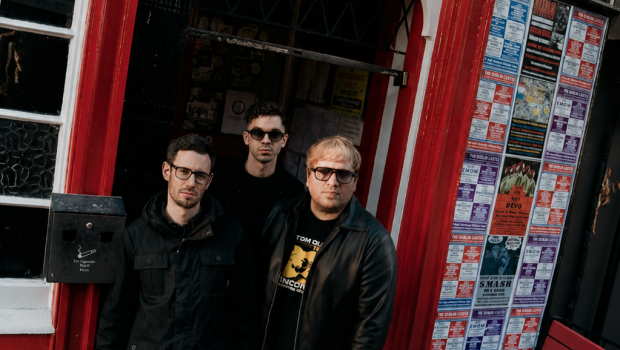
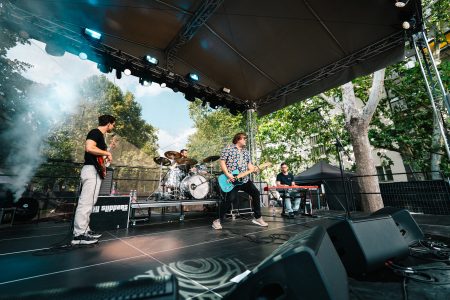
 Lazar from the Hungarian group, Dirty Slippers, discusses their plans, recording at Abbey Road Studios and their work creating the addiction and mental health support organisation, Suliturné.
First off, I’m in love with Where Did The Summer Go. It’s an indie triumph with rock undertones. Nothing is wasted and all the components work. How long did it take you guys to record such a massive track?
First of all, thank you – that genuinely means a lot. The funny thing is that the basic recording came together much faster than the final personality of the track. We already had the core song, but when our producer George Shilling got involved properly, we started pulling it apart and rebuilding the energy. I remember telling George that in my head I could hear this huge indie/punk-rock anthem – big guitars, hard drums, a wide chorus – and I was throwing references at him like Green Day, Goo Goo Dolls and Oasis. George immediately spotted that my original guitar tracks were a little too thin. I had recorded them on a Telecaster through a Vox AC15, which sounded cool but wasn’t quite giving us the weight we wanted. So we thickened the guitars, made the drums much punchier and played around with the synth and sequencer parts until everything felt right. The initial recording wasn’t painfully long, but the real creation happened during those weeks of shaping and reshaping it. Sometimes recording a song is about capturing it. This one was more about discovering what it actually wanted to become. And George is brilliant at that.
I read that you guys recorded at Abbey Road Studios. That must have been a memorable experience. So many bands and artists have recorded there. It must have been somewhat surreal?
Completely surreal! There are certain places where you walk through the door and immediately feel the history before anyone says anything. Abbey Road is absolutely one of them.
You know perfectly well that The Beatles, Oasis, Pink Floyd and generations of incredible musicians have worked inside those walls, so there is this strange moment where part of your brain is saying, “Act professionally, you’re here to work,” while another part is basically screaming, “What the hell are we doing in Abbey Road Studios?”
[Laughs.]
For a Hungarian band that started with no international infrastructure whatsoever, getting there was incredibly emotional.
But once the red light goes on, the mythology has to disappear for a while.
You still have to play the song.
And I love that contrast: one of the most legendary studios on Earth, but ultimately you’re still just four musicians trying to make three minutes of music feel honest.
I see Where Did The Summer Go has received a substantial amount of radio plays. It must feel gratifying that you’re making waves, especially in the UK.
Absolutely. We’ve now passed 150 international radio plays, and the UK reaction in particular means an enormous amount to me. Britain isn’t a market we’re trying to visit for a few months and then disappear from. We’re trying to build a genuine second home for Dirty Slippers here. We’ve toured Britain several times, played sold-out shows in London and Newcastle, built relationships here, and now we have British management and two UK PR teams working around the next chapter. When UK radio stations, magazines and listeners respond to the music, it feels different. There’s a wonderful phrase from The Big Takeover which called Where Did The Summer Go? “arguably the best indie song of the year.” You read something like that and think, Bloody hell. But the thing I’m proudest of is that people seem to hear the emotion underneath the chorus. It’s a bright song about something slightly darker: time disappearing, people changing, summers ending, relationships becoming memories. If somebody sings the chorus after one listen, brilliant. If they feel something underneath it as well, that’s even better.
SLIPPERS – WHERE DID THE SUMMER GO? (Official Video)
You’ve been a band now for 15 years. What motivates you guys to keep going?
You probably need a certain amount of madness to keep a rock band alive for 15 years. We’ve experienced almost everything: great concerts, terrible concerts, people joining, people leaving, rejection, money problems, industry promises that disappeared in our home country, incredible opportunities that came out of nowhere. But there is still something that happens when the four of us walk onto a stage and the first guitar comes through the PA. I still want that feeling.
And strangely, after 15 years, I feel more ambitious now than I did when I was 20. The UK chapter is a huge part of that. For years we dreamed about building something internationally. Now we’re not really dreaming about it anymore – we’re actually doing the work. And then Suliturné gives the band another reason to exist. A concert can make somebody happy for an evening. Sometimes a conversation after that concert can affect them for much longer.
That’s a powerful reason to keep putting the guitars in the van.
What’s your guys take on a brittle music industry? Everything has changed dramatically over the years. What’s your feelings regarding its state of it?
I think the modern music industry is more democratic and more brutal at exactly the same time. Twenty years ago, there were enormous gatekeepers. If the label, radio station or magazine said no, sometimes your journey ended there. Today you can release a song from your bedroom and theoretically reach somebody in Glasgow, Los Angeles or Tokyo before breakfast. That’s incredible.
But the other side is that there are probably a hundred thousand other songs asking that person for exactly the same three minutes of attention.
Streams have replaced sales, algorithms influence discovery, social media expects musicians to become filmmakers, comedians, marketing managers and content creators as well as songwriters.
And sometimes the industry talks obsessively about numbers while forgetting that music isn’t mathematics. Ten thousand passive streams are lovely. But watching 150 people scream your chorus back at you in a tiny club can tell you far more about whether your music actually matters.
So I don’t hate the modern industry at all.
I just think artists need to remember what the industry occasionally forgets:
The song still has to make somebody feel something.
Everything else is infrastructure.
As a collective you have aided young people through addiction and have given them a new light to follow. You’re an inspiration for doing so. So what made you start up the organisation Suliturné?
Thank you. That means a lot.
Although I’m always careful when people say we’ve saved lives, because I don’t think we have the right to take credit for somebody else’s fight or recovery.
What we can do is open a door.
Suliturné started in 2011 with a very simple realisation:
teenagers generally don’t enjoy being lectured.
Neither did I when I was sixteen.
[Laughs.]
But after playing music for students, we noticed that something changed.
The distance disappeared.
Suddenly we weren’t adults standing in front of them telling them how to live.
We were the people who had just played a rock concert for them.
So we started talking.
Drugs. Alcohol. Addiction. Bullying. Mental health. Bad decisions. Asking for help.
And the students started talking back.
Sometimes incredibly openly.
That was the moment I realised that music could be more than entertainment for us.
It could be the key that unlocks a conversation.
Fifteen years later we’ve visited more than 800 educational institutions and reached over 300,000 young people face-to-face.
I certainly didn’t imagine that when we walked into the first school.
Suliturné really is a breathe of fresh air. It gives young people an outlet, a voice, a vision. You have built from the ground up a steady ship, a hub of generosity and compassion. In essence, you’ve saved lives. Is it always something you wanted to pursue?
Not originally.
I wanted to be in a rock band.
That’s the slightly less heroic answer.
[Laughs.]
When I was younger, my dreams were about records, festivals, touring and standing on stages.
Suliturné wasn’t some grand plan I created at 21.
It grew organically because we began seeing what happened when students trusted us enough to talk.
I’ve had young people tell us things after sessions that they’d apparently never spoken about before.
That’s when the responsibility changes.
You realise this isn’t just another concert on the schedule.
But maybe somebody heard one sentence that made them speak to a parent.
Maybe they spoke to a teacher.
Maybe they decided not to take something.
Maybe they realised that asking for professional help wasn’t a weakness.
If Suliturné has helped create even some of those moments, then every kilometre we’ve travelled has been worth it.
The strangest thing is that the rock band and Suliturné now feed each other.
The music gives us access to young people.
And meeting those young people constantly reminds us why music still matters.
I listened to the other songs too. I’m deeply in love with The Best. It’s emotive and poetic, and it shows the band’s songwriting capabilities. It’s a love song, one with lyrics that resonate on a higher scale. How long did it take you to record such a colossal track?
Thank you. I have a very soft spot for The Best.
With that song, the emotional idea arrived much faster than the finished recording.
Some songs you have to intellectually build.
The Best wasn’t really like that. The basic emotion was already there.
The challenge was not ruining it.
[Laughs.]
It’s very easy when you’re producing a big emotional song to keep adding things because you want every moment to feel enormous.
But eventually you realise that the lyric has to breathe.
A love song becomes meaningless if the production is screaming louder than the person singing it.
So we spent much more time refining the arrangement and the dynamics than trying to make it complicated.
I’m very proud that you used the word poetic, because that’s probably what matters most to me about that song.
I studied Hungarian literature, so words have always mattered enormously to me.
For me, melody gets someone through the door.
Lyrics are what make them stay in the room.
And The Best is probably one of the most vulnerable songs we’ve released.
SLIPPERS – THE BEST (Official Video starring Anna Mészöly)
How are you guys with your mental health. Do you suffer through the darkness? Music must help though. It’s such a clutch for people.
Of course.
We’re human beings before we’re musicians.
There are periods where everything feels exciting and you’re convinced you’re about to conquer the world.
And then there are weeks where you’re exhausted, disappointed or wondering why the hell you’re putting yourself through all of this.
Being a musician can actually be quite lonely sometimes.
People see the stage, the photographs, the travelling and the exciting things.
They don’t necessarily see the rejection, uncertainty, financial pressure, lack of sleep or the hundreds of emails that receive absolutely no reply.
Music helps enormously.
Sometimes writing a song allows you to say something you couldn’t explain properly in a conversation.
But I also think we have to stop romanticising suffering.
Music can help your mental health. It isn’t a replacement for taking care of your mental health.
If you need to talk to somebody, talk.
If you need professional help, get it.
That’s something we tell young people through Suliturné too.
There is no medal for suffering alone.
And asking for help doesn’t make somebody weak.
Quite the opposite.
You guys are going be in Glasgow soon. I know you want to spread the wings of Suliturné and let people know more about the future and the outlet as a whole.
Glasgow has suddenly become incredibly important to us.
We’re playing Lucky Strike on 12 November, but I’m now looking at that visit as something much bigger than one Dirty Slippers concert.
We are actively trying to create the first UK Suliturné pilot in Glasgow.
We’ve now reached out to Glasgow City Council and local education and creative-sector people because I’d love to find the right school or youth environment where we can test the programme properly.
And I don’t want to simply export the Hungarian model and say:
“Here you go, Scotland. This is how you should do it.”
That would be arrogant.
We want to work with Scottish and UK educators, youth professionals and safeguarding experts and adapt the programme to what young people there actually need.
If we can play a Dirty Slippers concert at night and then use the same visit to start something meaningful with teenagers in Glasgow, that would be incredible.
My dream is that in a few years Suliturné isn’t described as a Hungarian programme anymore.
It’s simply a programme that started in Hungary.
There’s a big difference.
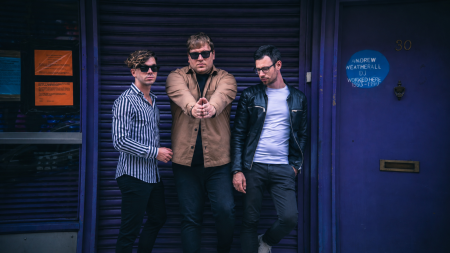 What’s next for The Dirty Slippers? Do you guys have anything on the horizon?
Quite a lot, thankfully.
Our next single, Blue Eyed Angel, arrives on 23 October, and then we’re back in Britain in November.
Glasgow is 12 November at Lucky Strike, and the UK run also includes more cities.
After that, we’re already building a much bigger 2027 UK and European campaign.
We’re applying for British and European festivals and showcases, talking about support opportunities with established artists and continuing to build the radio and press side properly rather than treating Britain like an occasional touring destination.
Then in February 2027 we’ll release our new album.
At the same time, the Suliturné story is becoming increasingly international, with the Glasgow pilot being the immediate goal and further UK opportunities developing behind it.
So there are effectively two stories happening at once.
Dirty Slippers is trying to become a genuinely established British-facing live band.
And something we started in Hungarian schools 15 years ago is beginning to travel internationally.
The strange thing is that after all these years, I don’t feel like we’re approaching the end of anything.
I feel like we’ve finally reached the beginning.
And that’s probably the most exciting place a band can be.