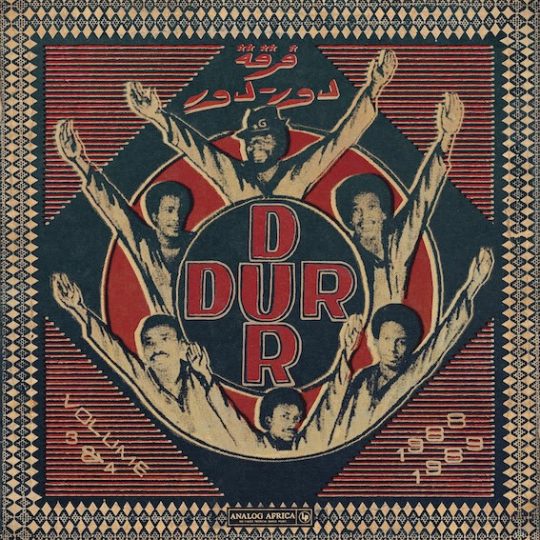
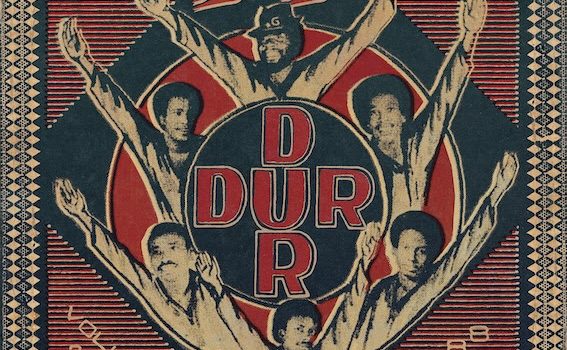
 The music of Dur-Dur Band captures the energy and optimism of 1980s Mogadishu. They were the prime exponents of a sound which blended Somali melodies with disco, funk, jazz, soul and reggae. As Dur-Dur translates as stream, all these elements could be compared to tributaries feeding into the smooth running of a larger river. It is this combination of local flavours and international influences that makes their music so appealing – refreshingly different while underpinned with familiarity and always eminently danceable. This latest compilation from Analog Africa follows on from the label’s 2018 release of the earlier parts of their catalogue, ‘Dur Dur of Somalia – Volume 1, Volume 2 and Previously Unreleased Tracks.’
Despite the joyful sound on these releases, they were created against a backdrop of mishaps and outright tragedy. Drummer Adan Handal recalls that Volume 3 was the most difficult of their recordings. It was recorded outdoors with a sound system and mixer connected to a tape machine. Winds whipped across their microphones ruining numerous takes. Singer Shimaali Ahmed Shimaali was badly injured on the way to a session which further delayed the recording and once he recovered, he immediately joined rival group, Iftin Band.
However, matters took an even worse turn in the lead up to Volume 4. Initially, the male lead vocalist, Baastow, left to live in Saudi Arabia and was replaced by Mohamed Ahmed Qomaal. Then, during a soundcheck a mixer had been connected to a defective power wire and keyboardist and bandleader Isse Dahir Qassim died by electrocution when he grabbed a microphone. Mohamed Karama was drafted in as a replacement keyboard player and his youthful enthusiasm helped the band on to new peaks.
After all this ill-fortune, it would have been justifiable if the records had sounded like the Somali equivalent of Morrissey and Leonard Cohen’s most morose moments but, fortunately, that is far from the case. Both albums begin with a brief introductory track called, logically enough, ‘Introduction’ followed by lengthier songs. Volume 3 gets fully into the swing with ‘Boodhari Sidiisii (Like Boodhari)’ with horns pumping and insistent but deft rhythms together with Baastow’s vocals driving the song which could have happily continued much longer but for quite an abrupt fade, a technique that is their favoured method of ending songs. Another facet of their sound is displayed on the funky ‘Shuuta Shuutee (Trad. Chant)’ with female vocalist Sahra Dawo complementing Baastow. The longest song in the collection at a shade over seven minutes, ‘Doobnimadey (My Maiden)’ is a winning combination of synths, horns and nifty rhythms with Dawo’s soulful vocals taking the lead, their interplay with Baastow being a particular pleasure.
A curiosity of the Somali music scene was that the leading bands would hone their craft performing in luxury hotels. The songs on Volume 3 were originally trialled with Italian tourists at the Jabba Hotel and the tunes were created with the expectation that they would still be enjoyable to people with no knowledge of the local language. An inkling of song topics could be derived by titles such as ‘Liibaanta (Victory)’ and the particularly buoyant ‘Run Maleysku Sheego (Let Speak The Truth)’. While most of the songs are high tempo, ‘Naf Jaceyl (Soulful Love)’ is an exception with its relaxed groove and Dawo’s intimately emotive vocals.
Volume 4 saw the band experimenting with sound. Inspired by how reggae was recorded, Handal set about emulating those sounds, employing methods such as pouring water on the snare or placing a towel over it and attaching bongos to his kit. He also purchased an electric drumkit from Italy which serves to give these tracks a sharper sound. ‘Waan Hubaa (I Am Sure)’ is indicative of this enhanced quality, some fantastic guitar playing weaving around the horns. With its devilishly difficult rhythms and electronic sounds, Alagariire (I Am Trembling)’ is the apex of the new recording techniques. Among the album’s highlights are the lightning groove of ‘Faduma (Women’s Name)’ and the cheeky organ, horn blasts and twirls, frantic basslines and cymbal smashes of ‘Adigaa I Dhalanrogey (You’ve Changed Me)’ while the light, funky guitars and horn serenades that give ‘Ileyn Hoheey (Oh! Surely)’ its dynamism are irresistible. ‘Is Yeel Yeel (Stop Pretending)’ is a delightful slice of Somali disco pop. Appropriately, the album concludes with an absolute dancefloor stomper, ‘Gariirtee (You Are Shaking)’, its rhythms enhanced by horn punctuation.
After the group had recorded ‘Volume 5’, which is available via Awesome Tapes From Africa’, war broke out in Somalia and Dur-Dur Band escaped to Ethiopia where they endured kidnapping before being smuggled out of the country. They are now scattered between the UK, Ohio and an Ethiopian refugee camp. However, the 18 tracks and 80 minutes of this two-album set display Dur-Dur Band’s vibrant sound at a time when they were at the peak of their powers.
Dur-Dur Band: Dur-Dur Volume 3 (1988) and 4 (1989) – Out 18 September 2026 (Analog Africa)
BAND – Adigaa I dhalanrogey (You’ve Changed Me)

I was editor of the long-running fanzine, Plane Truth, and have subsequently written for a number of publications. While the zine was known for championing the most angular independent sounds, performing in recent years with a community samba percussion band helped to broaden my tastes so that in 2021 I am far more likely to be celebrating an eclectic mix of sounds and enthusing about Made Kuti, Anthony Joseph, Little Simz and the Soul Jazz Cuban compilations as well as Pom Poko and Richard Dawson.








 & 4 (1989))