 This might seem blasphemous appearing on a Manchester-based website but I would argue that 4AD was the most important record label to emerge in the post-punk era, eclipsing even Factory Records. Although it would be impossible to deny the impact of a select few acts that Tony Wilson’s label is associated with (Joy Division / New Order and Happy Mondays), 4AD created a broader, high-quality catalogue of artists whilst retaining a distinctive label identity. In an era when music was still a male-dominated domain, they notably included a significant proportion of female fronted acts amongst their roster such as Cocteau Twins, Dead Can Dance, Throwing Muses, The Breeders and Lush.
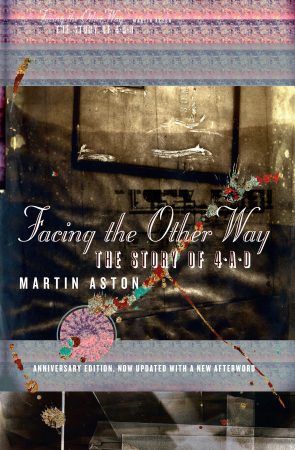
Martin Aston’s biography of 4AD, Facing The Other Way, is a comprehensive delve into the label over the course of 600 pages. Originally published in 2013, it has been reissued with a new afterword, the 13-year gap a deliberate echo of The 13 Year Itch, a series of concerts held at the London Institute of Contemporary Arts in 1993 that celebrated that particular anniversary for 4AD. One of the main attractions of this updated edition is that the afterword includes a rare in-person interview with Elisabeth Fraser, the phenomenal voice of the Cocteau Twins, a person who has shunned the limelight throughout her career and was the only major figure in 4AD’s history who did not participate in the original book.
The story is told in chronological order. After an introductory chapter concerning label founder Ivo Watts-Russell’s early years, it gives a chapter to each year between 1980 and 1999, before dispensing with their 21st century offerings more quickly. Because the label’s identity became clearly defined and associated with specific artists, particularly Cocteau Twins and Pixies (even though they are vastly different from each other), it is interesting to be reminded that their early releases were scattershot and that Bauhaus and Birthday Party records initially helped keep the label solvent. As Bauhaus were loathed by the music press, it meant that it took the label a long time for gain a positive reputation among critics.
Aston gained interview access to virtually everyone who was involved with the label during its peak period, from Watts-Russell through all the acts on the label to the press agents and backroom staff to create a study that is exhaustive but not exhausting. As the likes of label owner Ivo Watts-Russell and the Cocteau Twins’ Robin Guthrie are shy figures who avoided the limelight, this gives a fresh perspective. He also weaves his primary sources with quotes from the music press at the time.
However, despite his privileged access, it could not be described as a hagiography. It dispenses with the image of a happy family headed by “Uncle Ivo”; the reality was more difficult. Describing the issues with Guthrie, Watts-Russell likens it to Nick Mason’s comment about life in Pink Floyd, “things got so bad that we almost spoke about it” to reflect an understanding that they lacked the emotional vocabulary to confront their grievances. By putting quotes from the protagonists next to each other, Aston captures how recollections and interpretations differ even now. There is an acknowledgement that the situation is not helped by colossal drug consumption (speed and then cocaine) that is at odds with 4AD’s wispy, ethereal image.
The narrative has a particularly strong focus on the depression that eventually forced Watts-Russell to step down and the disillusionment that came with the realisation that running a record label had evolved into running a record company with its conflict between commercial aspirations and the original purity of motive. A turning point for their expectations was ‘Pump Up The Volume’ by M/A/R/R/S, very much an atypical release for the label, getting to number one in the UK singles chart in 1987 and it is easy to forget what a big deal it felt at the time for an independent release to achieve such mainstream success. Consequently, running the label becomes an ever more complicated web of dealings and interconnections, from a tie-in with major labels including Warners to setting up the short-lived label Guernica for one-off projects and providing assistance to the 1990s independent label, Too Pure.
As is only fitting for a book about 4AD, the cover and design is gorgeous, courtesy of Vaughan Oliver, the label’s design supremo. Surprisingly, he appears to have been the closest the label came to being a traditional rock’n’roll animal and gives especially good copy. In particular, his story about the cover to The Breeders’ album ‘Pod’ is worth seeking out.
One of the delights in Facing The Other Way is its recall of tiny details, such as both Pixies and Throwing Muses drummers coming from a marching band background. It is also amusing to read of mind-blowing plans that did not come to fruition including Dif Juz produced by Lee Perry and mixed by Guthrie.
It is striking to realise that 4AD has continued without Watts-Russell for a longer period than he was at the helm and continues as a home for many excellent acts including Big Thief and Aldous Harding, as well as Kim Deal. While it might not inspire completists as it once did (and its design excellence made it especially appealing to collectors), this is a different era where streaming has diminished the role of label identity. Facing The Other Way makes for an engaging and detailed account of a particularly fertile period for independent music. While it is an essential read for 4AD fans, it should also appeal to anyone interested in music of that era and the intersection between creativity and commerce.
Martin Aston – Facing The Other Way: The Story of 4AD – Published 12 March 2026 (William Collins)

I was editor of the long-running fanzine, Plane Truth, and have subsequently written for a number of publications. While the zine was known for championing the most angular independent sounds, performing in recent years with a community samba percussion band helped to broaden my tastes so that in 2021 I am far more likely to be celebrating an eclectic mix of sounds and enthusing about Made Kuti, Anthony Joseph, Little Simz and the Soul Jazz Cuban compilations as well as Pom Poko and Richard Dawson.