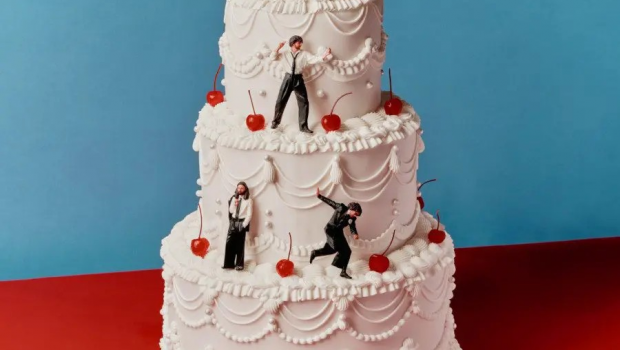
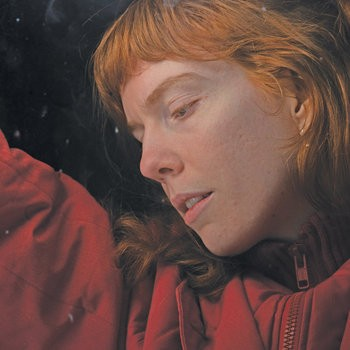
 Even though she is a contemporary artist, there is the air of a recently rediscovered psych-folk great to Elanor Moss’s debut album. Her voice has an exquisite beauty which is further emphasised by the backing from classical guitar and strings. However, as its title indicates, ‘The Knife, The Needle’ has a dark edge. These are implements that can create severe damage and the album explores the consequences of love complicating the relationship between people.
The album’s origins are drawn out, a three-year period of writing and demoing songs, restarting therapy which generated an understanding of herself and how family feeds into her actions. An initial more rollicking recording of ‘The Knife, The Needle’ in New York was scraped and Moss retreated to a cabin near her parent’s house in the Scottish highland. What results is a record that has a quiet gravitas to it, full of songs of raw emotion.
The mood of chilling intimacy is set with the startling opener, ‘Fixer’. Beginning with guitar and sombre horns (saxophone, flugel and tenor horn), Moss’s voice induces shivers. From her initial desire to “buy you pretty things / but I can’t even make my rent”, events soon take an ominous turn with the admission, “I’m afraid that if you show me the knife / I might use it on you baby.” As stabbing fiddle and violin are added, the tension mounts. However, there is a positive resolution with the thought that “maybe what we thought of as a knife / is just a needle we could use / to stitch the wound.” When needle imagery appears in song, it is usually in the downright depressing style of Neil Young’s ‘The Needle and the Damage Done’ whereas ‘Fixer’ gives a first indication of the complexity Moss embraces.
The recording is so stilled that it is possible to hear a sharp intake of breath at lead single ‘Sarah Waiting In The Car’ begins. The song highlights the power of her vignettes. It starts with a sense of cosy reverie sat at a bar with carols on the radio, fingerpicking guitar and soft horns establishing that atmosphere. From the first chorus of “you’re so tender baby”, the next verse provides an immediate jolt through the lines “then you take me by the kitchen sink / fist around my neck.” While the instant horror comes from those lines, the subsequent mention of housemates being home and not noticing (maybe choosing not to notice) adds another layer. The following chorus changes to “you’re so violent baby” and Moss’s voice sounds fragile, almost broken. There is then a shift between “you’re so violent” and “I’m so violent” on the following chorus which leaves open to interpretation the idea that it could be a shift in narrator or a manifestation of her complicity. It is rare to encounter a song of such complexity that juxtaposes with such gorgeous music.
Even when she sings “do” 28 times consecutively on ‘Again My Love’, it sounds more like an attempt at self-distraction rather than comforting in a song of absence but it does close with the revelation, “something grows in you you couldn’t find / before the loss.” On an album centred around vocals and lyrics, an instrumental offers a rupture or intermission. ‘Improvisation’ gives the appearance of living up to its title, a break from the lyrical terrors and revelations that have gone before, although the atonality of the violin could be indicative of post-traumatic stress.
There is a domesticity to many of the lyrical references but that does not preclude drama. ‘You Are Coming Home Tonight’ finds clothes on the line but it does not stop the narrator from looking to their partner as a storm or god from which to seek absolution. With minimal intercessions from the strings and horns, the song has a stark mood. From Moss’s whispered introduction, ‘Secrets of the Universe’ is intimate with secrets being traded across the kitchen table and the thought occurring that she wants to be the kind of woman who owns a teapot. There are moments where the song sounds so minimal that it could evaporate. Again, it has a box within a box structure with her revealing “what I thought was a wall was a door / that you open more and more” while the horns add a soft swelling. Although the setting is different, ‘Clothes in the Kitchen Sink’ still revels in mundanity, a touring existence in budget motels that contrasts with her lover’s jet-set, five-star hotel lifestyle. The small flashes of fiddle give it a mournful, countryish flavour.
The layering is evident in ‘Louise’, the narrator’s elegy for her grandmother now living on tennis reruns which contrasts with her young love which was like a bullet train and references to insanity in the family. There is ambiguity as to whether the titular heroine is the granddaughter or her elder, perhaps reflecting the interconnectivity between generations. It is all suffocatingly fraught, the hushed vocals brushing against subdued horns. The sense of never really knowing is apparent from the opening couplet to the final song ‘The Way That It Feels’ (“oh and the way that it feels to know you / oh and the way that it reveals I don’t know you.”) To the accompaniment of classical guitar and birdsong, she sings of love and tenderness but comparing that tenderness with an open bruise, purple wound, lullaby and baby’s cry is indicative of how complex the emotions evoked can be.
It is hard to imagine ‘The Knife, The Needle’ in anything other than its finished form which suggests the decision to rerecord it was a wise one. The quiet approach maximises the impact of Moss’s voice and her thoughtful lyrics that are often revelatory. With such a fully formed record, it is not easy to imagine her next steps but for now she can bask in the success of a stunning debut.
Elanor Moss: The Knife, The Needle – Out 21 August 2026 (Merge Records)
Moss – Sarah Waiting in the Car (Official Music Video)

I was editor of the long-running fanzine, Plane Truth, and have subsequently written for a number of publications. While the zine was known for championing the most angular independent sounds, performing in recent years with a community samba percussion band helped to broaden my tastes so that in 2021 I am far more likely to be celebrating an eclectic mix of sounds and enthusing about Made Kuti, Anthony Joseph, Little Simz and the Soul Jazz Cuban compilations as well as Pom Poko and Richard Dawson.