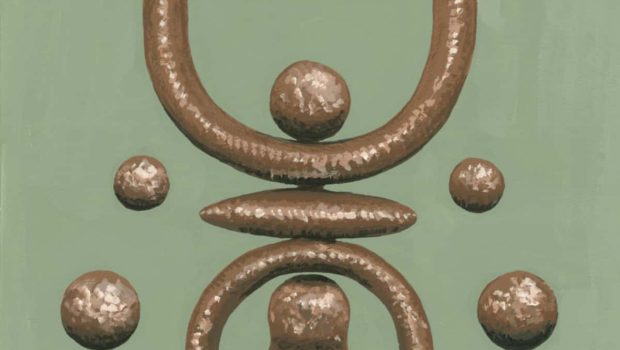
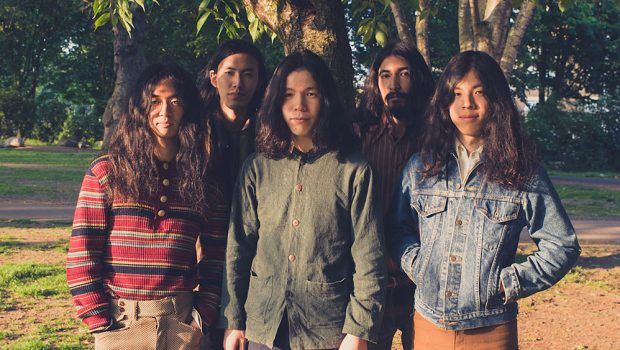
 There are numerous records in my collection that include the command “Play Loud” on their sleeve. It does not appear far-fetched to imagine Maya Ongaku’s latest conveying the suggestion that it should be played quietly. After a period of international touring in support of their decidedly undemonstrative debut album ‘Approach to Anima’ where the audiences grew larger and the performances louder, the trio found themselves drawn to the quiet spaces between the noise. This led them to the concept of ‘Nothing Space’ where boundaries dissolve: those between sound and silence, sea and sky, past and future.
To create ‘Nothing Space Music’, the band built their own recording studio, transforming a large soundproof building into the Nothing Space Studio. There, they worked in total isolation performing, recording, mixing and designing the album. The result is informed by that state of immersion. When silence and music are discussed, it is easy to think of John Cage’s 4’33” where the musicians do not play their instruments for the entire period and the audience are nudged into listening to ambient sounds as there is never absolute silence. With ‘Nothing Space Music’, there are never large gaps, just an easy flow with occasional spaces between notes. It is a very fluid album which captures the spirit they describe as 自然発生 (shizen hassei), or “spontaneous occurrence.”
A glance at the eight track titles gives an indication of their aspirations for the album. It is bookended by Vanishing Waves and Permanent Waves (it can be safely assumed the latter is not a reference to visiting the hairdresser) while also including the likes of Thinkingscape and Flowing. The notion of space can be seen as both the space within the music but also a reflection of their psychedelic influences. It is very much head music, designed for inner trips and indulging the imagination.
Aptly, Vanishing Water fades in. Characteristically, Tsutomu Sonoda’s vocals are gentle, pleasingly devoid of any macho echoes, almost soporific but pleasingly mellifluous. Accompanied by piano, acoustic guitar, synthesiser and Sei water Whale D, the effect is calming. It is easy to imagine that a blood pressure reading taken at the end of the track would be much lower than at its beginning.
While the album works as a continuous mood piece, the tracks do have their individual background stories and concepts. Despite the English titles, Sonoda sings in Japanese but apparently Astral Voices explores the moment when art comes into being, reflecting his belief that inspiration is not something to be chased but waited for patiently in silence. Musically, it includes clarinet (an instrument that helps give their music its distinct melodic quality) and bass to make it one of the record’s most immediately enticing songs. A love song written from the perspective of the dead, You are Silence was written during Japan’s midsummer season of Odon where it is believed that the spirits of ancestors return and Sonoda imagines that it would be like to be one of those spirits looking over a loved one. Judging from the song, it would be a serene, weightless experience. While the track includes the TR 8S rhythm machine, it surely must be set to its slowest pace allowing the synth and piano melodies alongside lullaby-like vocals to set the mood.
Even though kick drum is listed on the instrumentation for most tracks, the rhythm in Maya Ongaku’s music is never forceful, no four to the floor beats for them. It flows in part from Ryota Takano’s bass, alongside random percussion items so Thinkingscape includes Sleigh bells, Caxixi (an instrument make of seeds or particles, shaken to produce sound) and Güiro (a hollow piece played by rubbing a stick along its notches.) It adds to the mesmerising impact of the track’s drones and a melody that would make a fitting soundtrack to footage of a flower’s petals unfurling. Flowing even features a rare appearance outside the confines of an infant school music lesson of the triangle while Shoei Ikeda’s flute is particularly beguiling and the field recordings add to the idea of a trickling, tiny river. A nut shell shaker appears on Hisoku Blue, the song enhanced by Ikeda’s sensuous but melancholic saxophone.
It is entirely appropriate that ‘Nothing Space Music’ ends with Permanent Waves which sees Maya Ongaku at their most deeply introspective, Sonoda’s mumbled vocal cosying up to acoustic guitar and synth while percussive ripples add to the spell. Taken in its entirety, it is a very special record which stands apart from the frenetic nature of the modern world and the music that soundtracks it. Maya Ongaku create their own unique musical style which while not demanding attention thoroughly rewards it. Lacking grand gestures, instead it benefits from an accumulation of small details to construct something of delicate beauty. With its understated, unhurried melodies making it an accessible listen, it is the ultimate chill-out record.
Maya Ongaku: Nothing Space Music – Out 7 August 2026 (Guruguru Brain)

I was editor of the long-running fanzine, Plane Truth, and have subsequently written for a number of publications. While the zine was known for championing the most angular independent sounds, performing in recent years with a community samba percussion band helped to broaden my tastes so that in 2021 I am far more likely to be celebrating an eclectic mix of sounds and enthusing about Made Kuti, Anthony Joseph, Little Simz and the Soul Jazz Cuban compilations as well as Pom Poko and Richard Dawson.