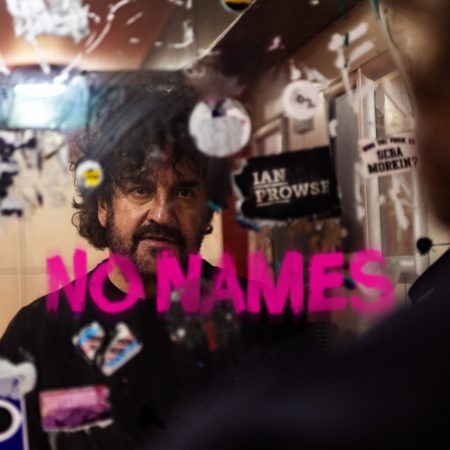
 As Elvis Costello observed in 1981’s ‘Big Sister’s Clothes’, “passion went out of fashion.” It is a complaint that has been commonly raised since but, judging by ‘No Names’, no one has told Ian Prowse. On his twelfth album, he has produced a work that is politically committed, outspoken and highly passionate. Every bit as importantly, it is a memorable record packed with energy, soaring melodies and memorable tunes.
While he has been dubbed ‘the Scouse Springsteen’, many of the finest moments on ‘No Names’ delve heavily into Celtic soul and would sit happily on Dexys Midnight Runners’ ‘Too-Rye-Ay’. A prime example is the Clash-referencing ‘Rendezvous Point’ featuring additional vocals from his 14-year-old daughter, Rosalita, together with fiddle from The Waterboys’ Steve Wickham which combines with the horns to give the song an irresistible swing. Good use is made of his contacts book with Costello, for whom Prowse has opened on his last three tours, providing ravaged vocals on ‘The Cleaner’ which contrasts the life of the poorly paid manual worker with that of a Guardian journalist. While there are far greater enemies of working people than writers at that particular newspaper, those reservations can be cast aside in the light of the song’s heady northern soul beat, horns and strings.
Ian McNabb contributes 12-string guitar to the anthemic opening track, ‘To The Letter’. While approvingly namechecking Mick Lynch and Fidel Castro, Prowse takes a pop at a schoolboy revolutionary who in adulthood sends his kids to independent schools and engages in creative accountancy. With its big chorus and weaving violin line, it has a buoyant energy. Damien Dempsey adds a couple of verses to ‘When Bobby Was Alive’, a song reflecting on the legacy of Irish republican prisoner, Bobby Sands, whose death on hunger strike in 1981 was a defining moment in the Northern Ireland conflict. The opening verses from Prowse celebrate Sands’ love of Freda Payne’s ‘Band of Gold’ and give it a Celtic soul backing to match before the song heads in a more traditional Irish music direction as Dempsey joins the fray before a final lament is sung by Cavan singer Fiona McConnell.
His sympathy with revolutionary figures is also demonstrated by the Latin tinged ‘Black Messiah’, a tribute to the Black Panther Fred Hampton whose killing by the tactical unit of the Cook County State Attorney’s Office is often viewed as an assassination at the FBI’s behest. It is also indicative of his willingness to throw in musical curveballs; its light funk feel and use of flute gives the song a quality distinct from anything else on ‘No Names’. Prowse emphasises Hampton’s work unifying the community and the sampled voice warning of the dangers of fascism feels especially timely.
Led off by harmonica blowing and handclaps, ‘Keynote Speech’ ventures into folk troubadour territory and calls out societal injustice (“I’d love to holiday in sunny Canaan… / but you can’t go slapping on sunscreen / when there’s been murder all over the land.”) The She Sings Wakefield Female Choir contribute a stirring chorus of “Enough is enough is enough” while a beguiling sax solo adds a further layer to the song. A song of friendship and defiance against encroaching age, ‘Stand Your Ground’ builds from acoustic guitar and mandolin into huge verses and even larger choruses while horns blaze. An element that is striking about Prowse’s songwriting is his use of unexpected references, in this case to Titus Oates, an English priest who fabricated the Catholic plot to kill King Charles II.
The title track is Prowse’s song of the streets with its code of silence, bristling with the real threat of violence. Even when the pace slackens on ‘Born in a Merry Hour’, the strings swell in a heart-tugging fashion. ‘Mo’s Wheel’ is a fine piece of storytelling, taking in the precarity of delivery work and the subsequent temptation of criminal endeavour which pays much more handsomely but has a significantly greater level of risk. A mournful trumpet refrain is twinned with the song’s inevitably unhappy conclusion. That storytelling vein is maintained on the closing ‘300 Miles From Home’, a tale of relationship breakdown and drinking set at Christmas time. Starting as an acoustic ballad, it gains momentum with the addition of strings and it is easy to imagine an audience holding phones aloft and singing together.
On ‘No Names’, Prowse displays a highly attuned sense of justice, an adherence to the notion that songs should mean something and relate to issues, especially how power impacts on people. Combining this with music that is dynamic, anthemic and well suited to his heart on sleeve vocals makes for an emotionally engaging listen.
Ian Prowse: No Names – Out 3 July 2026 (Learpholl Records)
Point – Ian Prowse (feat. Steve Wickham & Rosalita Prowse)

I was editor of the long-running fanzine, Plane Truth, and have subsequently written for a number of publications. While the zine was known for championing the most angular independent sounds, performing in recent years with a community samba percussion band helped to broaden my tastes so that in 2021 I am far more likely to be celebrating an eclectic mix of sounds and enthusing about Made Kuti, Anthony Joseph, Little Simz and the Soul Jazz Cuban compilations as well as Pom Poko and Richard Dawson.