 Chris Difford is one of pop’s greatest storytelling lyricists. Classics like the kitchen sink drama ‘Up The Junction’ (a rare song in which the title makes its solitary appearance in the final line) and the countrified tale of poverty and addiction ‘Labelled With Love’ were both UK top ten hits over 45 years ago and have lost none of their power to the intervening years. His songs display a love of language and rhyming schemes that takes liberties with convention. Even the details of originally meeting his songwriting partner, Glenn Tilbrook, has wonderful detail. Difford posted an ad in a sweetshop window reading, “Guitarist wanted for band with record deal and tour.” Of course, there was no record deal, tour or even band but so began a partnership that has endured, notwithstanding a few blips, for over fifty years.
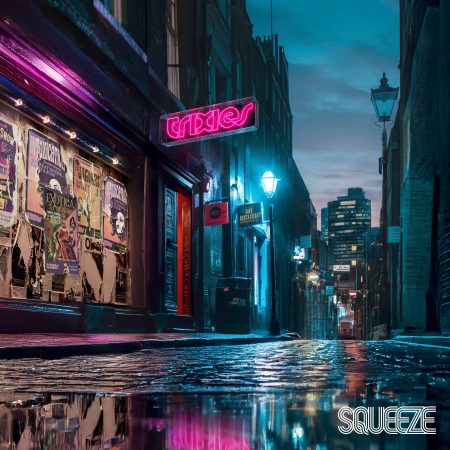
The background to their new album, ‘Trixies’, may be their most remarkable plot twist. These are songs written in 1974 when Difford was 19 and Tilbrook 16. At the time, they were only recorded as demos. In 2023, a friend presented them with a better-quality recording of those demos and they were amazed at the standard of the songs. With their musicality having now caught up with their ideas, they decided that they would now be able to do justice to those songs.
‘Trixies’ is set in a fictional nightclub and was inspired by Difford reading a short story collection by Damon Runyon about a group of characters inhabiting a 1930s/40s New York nightclub. In hindsight, Difford thinks his version leans towards the 1960s but it is a collection borne of imagination rather than experience. He claims to have only altered three lines from the original lyrics so one concern I had before listening to ‘Trixies’ was how well they would translate to 21st Century attitudes as there are some early Squeeze songs, especially on the ‘Cool For Cats’ album, where the laddish cheeky chappy personas of their characters now feel troubling. Fortunately, such fears are unrealised.
Even though it is set up as a rock opera, the thirteen songs that make up ‘Trixies’ show that Difford and Tilbrook retain the mastery of the three-minute pop song that originally saw them touted as “the new Lennon and McCartney.” In reality, their approach was much more clearly demarcated than The Beatles with Difford as the lyricist and Tilbrook writing the music and, being blessed with the clearer, more wide-ranging voice, taking most of the lead vocals. Band bassist and the album’s producer Owen Biddle made some changes to the running order and the original narrative arc but ‘What More Can I Say’ serves as a natural introduction with Tilbrook sketching over relaxed, piano-led backing a scene of cocktails, sophistication, lipstick smears and stranger fears. ‘You Get The Feeling’ introduces a resident singer known as Lucy Bourbon while jazzy guitar chords, light strings, keys and harmonies compliment the mood of honeymoons and champagne.
Quickly the mood becomes more threatening. ‘The Place We Call Mars’ sees a character laying on a hospital floor “blood on her face and spikes in her mind”. The chorus reflects the damage (“you can’t mend a mind but you can mend a face”) as Difford’s rougher voice blends with Tilbrook’s. With its guitar solos, it is one of the moments where the musical style harks back the song’s 1970s origins. Keyboard lines reminiscent of Sparks, harmonies and synth squiggles make ‘Hell on Earth’ one of the most immediately exciting songs, while the lyrics get darker (“in the mirror / I play spot the killer.”)
Difford takes the vocal lead on ‘The Dancer.’ Whereas in earlier times his vocals had quite a gruff quality, now they sound understated and sympathetic describing an aggressive environment riddled with drooling old men, synth washes heighten the atmosphere. Starting with vocal harmonies, ‘Good Riddance’ sounds at odds with what its title would suggest and boasts some lovely jazz guitar and baroque keyboard lines, although it is populated with “savage women with tongues like razors.”
Set on “one of those Victorian night”, ‘Don’t Go Out In The Dark’ has its drama heightened by keyboard and guitar stabs, a song serving as a reminder that in every era, nighttime can be dangerous. With its fast pace and Tilbrook/Difford combined chorus, ‘Why Don’t You’ has elements in common with their first chart hit, ‘Take Me I’m Yours’. Twenty-four hours later, the narrator of ‘Anything But Me’ is consumed with anxiety as they confront “Big Fat Harry” whose “boys are in the alley / waiting for me”. The other Difford lead vocal ‘It’s Over’ conjures emotional disappointment and overwhelming weariness with great sympathy.
Beginning with a rock’n’roll strut that recalls T Rex’s ‘I Love To Boogie’, ‘The Jaguars’ shows the moment where excitement turns to terror (“then without warning there’s a shot in the air / the doors are flying open and I’m last down the stairs.”) The album ends on a musical high with parts one and two of the title track which have two of the record’s best tunes. ‘Trixies (Part Two)’ makes a fantastic finale, packed with detail, descriptions of heroin dealers, rock stars of the 80s, models, comedians, actors, chameleons, people who carry something lethal, all driven along by piano and rambunctious saxophone that could be the soundtrack to a revealing dance routine.
Squeeze bring these long-forgotten demos to life with pizzazz. While occasionally the lyrics do sound like the imaginings of an especially precocious and entertaining young writer, relying more on archetypes than hard-earned experience, in combination with music of the highest quality, it makes ‘Trixies’ a late period highlight.
Squeeze: Trixies – Out 6 March 2026 (BMG)
– Trixies Pt. 2 (Official Visualiser)

I was editor of the long-running fanzine, Plane Truth, and have subsequently written for a number of publications. While the zine was known for championing the most angular independent sounds, performing in recent years with a community samba percussion band helped to broaden my tastes so that in 2021 I am far more likely to be celebrating an eclectic mix of sounds and enthusing about Made Kuti, Anthony Joseph, Little Simz and the Soul Jazz Cuban compilations as well as Pom Poko and Richard Dawson.