 Ask a music fan to choose a band that personified the Scottish independent scene and it is likely that there would be lots of different answers. Perhaps it would be the feedback drenched pop of The Jesus and Mary Chain or the trad rockisms of Primal Scream. Alternatively, it could be Belle and Sebastian’s literate 60s influenced pop, the exploratory post-rock of Mogwai, the folkish King Creosote or Arab Strap’s insular narratives. What that diversity proves is that the music coming out of Scotland from 1985 until the end of the 20th Century was not beholden to any one style.
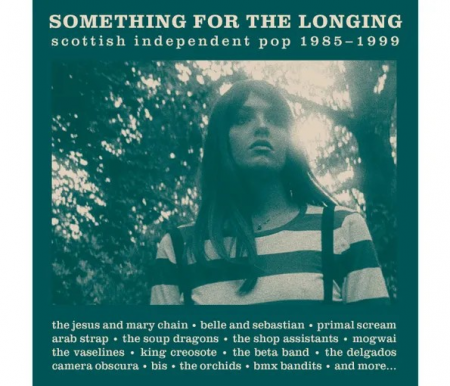
All these groups are present and correct on ‘Something For The Longing’, a 3CD 67-track compilation compiled by Grant McPhee as a companion to his book Postcards From Scotland, an oral history consisting of over 100 interviews with those who were part of the country’s music scene from1983-1995. With each band limited to one track it means that whilst many of the biggest names are included, there are plenty of lesser-known acts, including some who to me were most synonymous with the Glasgow scene at the time.
Although there were a host of bands that continued the lineage of Orange Juice’s vulnerable pop, many took the spiky rhythms and politics of Fire Engines and Josef K, twisting them into gnarly new configurations. At the furthest edge were Stretchheads, represented here by ‘A Freakout’, full of monster riffs, distorted bass lines and screams courtesy of P6, whose confrontational performances would see him wandering among the audience and screaming in their faces. With more of a melodic edge alongside their stop-start rhythms and defiantly Glaswegian-accented vocals, Badgewearer’s ‘Buspass Conspiracy’ still sounds wonderfully fresh. The clattering, chaotic 80 seconds long ‘Noel Edmonds’ (associated with the naff mainstream culture they hated) is not the best representation of Dawson, a band capable of joyous live shows. The wonderfully named Whirling Pig Dervish rattle through the 92 seconds of angular guitars and abrasive vocals that constitute ‘Whip’.
These acts were making their racket at the cusp of the 1990s but by the middle of the decade a number of new acts had taken up the baton. Into what had been a male-dominated scene came Lung Leg who added some Kleenex influences to the mix and their 68-second long ‘Punk Pop Travesty’ is one of my favourite songs on the compilation, all twisting guitars and sweet-sour shouty melodies. The references to song length indicates how guitar solos were anathema to these groups; the ethos was make your point quickly. The Yummy Fur manage this most succinctly of all with the 45 seconds of ‘Typical of Boys’ which fits two false endings into this timespan. Being a small scene, there was a fair degree of hopping between bands with ‘Lugworm’ including members of Lung Leg and Yummy Fur; their ‘Sweaty Says’ is a delightful romp of punk-jazz chords and rhythms.
The compilation provides a broadly chronological overview, kicking off with the JAMC’s ‘You Trip Me’, probably their ultimate combination of feedback and buzzsaw pop. Of all the pop leaning C86 bands, The Shop Assistants were the most convincing and ‘I Don’t Want To Be Friends With You’ is a snappy dismissal of the possibility of being friends with an ex. Their vocalist, Alex Taylor, went on to form The Motorcycle Boy who felt disappointing in comparison but the more conventional riffs of ‘Big Rock Mountain’ does suit her emotionally rich voice. Primal Scream were in chiming Byrds guitar and fey vocal mood on ‘Gentle Tuesday’, a world away from the Rolling Stones tribute act they morphed into, while The Soup Dragon’s ‘Soft As Your Face’ comes from a time before they started incorporating dance influences. Apart from The Shop Assistants, The Jasmine Minks are the best of the guitar pop bands, ‘Cuts Me Deep’ being full of chiming chords, organ and emotional depth.
Disc Two has the least well-known names with BMX Bandits probably the most familiar to a wider audience. This may have been a reflection of how during the first half of the 90s the media were so heavily focussed on Madchester, then grunge and Britpop that other sounds were unable to cut through as there is still plenty worth investigating. In addition to the aforementioned Lung Leg and Yummy Fur, Long Fin Killie’s ‘The Lamberton Lamplighter’ uses its quiet-loud dynamic effectively, throws some fiddle into the mix and Luke Sutherland’s storytelling gives a good indication of why he subsequently became an acclaimed author. A horn section gives The Stanleys edgy ‘Royal Blue’ added pizzazz. Its distorted sonics distinguishes Spare Snare’s ‘Wired For Sound’. Nostril’s ‘Token Song About Foreign Politics’ has a title and sound that suggests a kinship with the mighty Minutemen and is all the more enticing for it.
Whereas the first two discs contain 25 and 24 tracks respectively, there are only 18 on the final disc which reflects that songs were no longer sticking to the three-minute or under guideline by the second half of the 90s. It was a period during which a number of Scottish bands achieved wider popularity with Belle and Sebastian at the forefront of this renaissance. Their epic ‘Lazy Line Painter Jane’ is the featured track. The Chemikal Underground label was at the epicentre of this later blossoming. It was run by The Delgados whose ‘Monica Webster’ is a piece of scuzzy pop that is a world away from the rich, string-laden sound they went on to develop and which saw ‘Pull The Wires From The Wall’ end up as number one in John Peel’s 1998 Festive Fifty. Amongst other acts, they also put out early releases by Arab Strap, Bis and Mogwai. Arab Strap’s most famous song, ‘The First Long Weekend’, a catalogue of dead-end decadence, features while Bis who were falsely presented as the first unsigned band to appear on Top of the Pops (they were already signed to Chemikal Underground) and their ‘Keroleen’ bursts with youthful energy.
It was the period most marked by each act being completely different from each other as shown by the inclusion of El Hombre Trajeado’s inventive, restrained post-rock ‘Logo’, The Beta Band’s difficult to place, vaguely psychedelic, dub and krautrock tinged ‘Inner Meet Me’, the frenetic ska of The Amphetameanies’ ‘Last Night’ and an early attempt at the classic songwriting that would define Camera Obscura on ‘Your Sound’. Appropriately, the compilation ends with the ten-minute plus ‘Christmas Steps’ from Mogwai. It would have been inconceivable at the time that their epic, predominantly instrumental post-rock soundscapes would end up scoring them a Number One album in the 2020s.
Over the course of a 67-artist collection, it would be ridiculous to expect to like every single track but the overall quality on ‘Something For The Longing’ is high. It gives a good indication of the musical variety and creativity coming out of Scotland over a period of a decade and a half. It was a scene not tied down to a specific sound or sensationalism but in which there did seem to be a collegiate spirit. It was a representation of independence at its best.
Various Artists: Something For The Longing – Scottish Independent Pop 1985-1999 – Out 24 April 2026 (Cherry Red)
Leg – Punk Pop Travesty (from Hello Sir)

I was editor of the long-running fanzine, Plane Truth, and have subsequently written for a number of publications. While the zine was known for championing the most angular independent sounds, performing in recent years with a community samba percussion band helped to broaden my tastes so that in 2021 I am far more likely to be celebrating an eclectic mix of sounds and enthusing about Made Kuti, Anthony Joseph, Little Simz and the Soul Jazz Cuban compilations as well as Pom Poko and Richard Dawson.