 Altın Gün translates from Turkish as “Golden Day.” The Amsterdam-based band provide an impressive example in how to evolve a sound over the course of a career. Starting off as a predominantly Turkish psych groove band on their 2018 debut, ‘On’, they swiftly received recognition for its 2019 follow-up, ‘Gece’, which was nominated in the Best World Music Album category at the Grammy Awards. Over their subsequent releases they have added synth pop and dream pop textures.
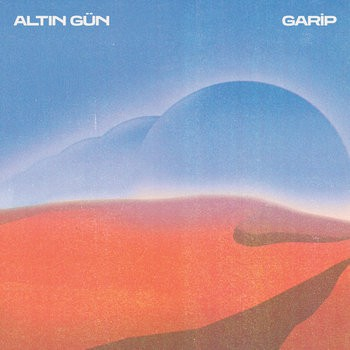
The sixth album and first slimmed down to a five piece after co-vocalist Merve Daşdemir left the band, ‘Garip’ which translates as ‘Strange’, is their most sophisticated and far-ranging thus far. It is a tribute to Anatolian folk bard Neşet Ertaş. He was a singer, lyricist and baglama virtuoso whose status nationally could be compared to Bob Dylan or George Gershwin and is reflected in the fact that when he died aged 73 in 2012, his funeral was attended by 10,000 people including Turkey’s Prime Minister and Leader of the Opposition. Altın Gün vocalist, keyboard and baglama player Erdinç Eçevit, whose parents were from the same area of Turkey, grew up listening to Ertaş. The album consists of ten Ertaş compositions that have been reinterpreted and given an expansive new sound that takes in twangy guitar, heavy and funky bass lines, string arrangements, saxophone bursts and synthesiser atmospherics. It creates an entirely new approach to songs that were originally sparse but also retains the original emotionality of the songs.
What is striking about the translations is that the poetry is incredibly florid by the standard of Western song lyrics but is clearly heartfelt. The opening lines of first track, ‘Neredesin Sen’ (‘Where Have You Gone’) are a classic example (“My sweet-accented, shy-graced beloved who understands my troubled state / My heart is always searching for you, where have you gone? / My sweet-tongued, cheerful, gazelle-eyed one.”) Eçevit, delivers his lines with appropriate passion, reflecting that these songs were the Turkish equivalent of the blues. Jasper Verhulst’s menacing basslines give the song a goth rock quality in combination with fluid percussion, baglama and twangy guitar.
‘Gönül Dağı’ (‘Seared Heart’) was the first song to appear on a You Tube search for Ertaş’s music. The Altın Gün version adds numerous layers to it, from its opening synth washes, loping and relaxed basslines to a string arrangement from the Stockholm Studio Orchestra. Eçevit’s vocal here is more understated but captures the Anatolian belief that love is both sacred and sorrowful.
Many of the record’s best tracks feature strings which bear the influence of Egyptian pop, Bollywood soundtracks, Turkish Arabesques and French / Italian compositions. ‘Suçum Nedir’ (‘Am I To Blame?’) is a particular highlight, a smouldering six-minutes where Eçevit’s subtle delivery is interspersed with lush string embellishments that recall laidback early 70s soul and some gorgeous sax playing. Introduced by highly flexible percussion,’ Gel Yanıma Gel’ (‘Come Next to Me’) uses orchestral swells and stabs to enhance the drama of a funk-driven bass and weaving baglama to deliver an intoxicating and impassioned tune.
Snaking and whirling synth lines give ‘Öldürme Beni’ (‘Don’t Kill Me’) a drama to match its title and opening lines (“my chest has been devoured, consumed by the hand of love”) while the baglama and Thijs Elzinga’s guitar give ‘Niğde Bağları’ (‘The Vineyards of Niğde’) a psych groove flow. The album’s one instrumental, ‘Benim Yarim’, has plenty to fill the space left by vocals – guitar, synth and baglama runs as well as fluid basslines. It takes the opportunity to highlight the quality of the rhythm section completed by Daniel Smienk (drums) and Chris Bruining (percussion). The most melodramatic sentiments can be found on the lovelorn, infatuated ‘Zülüf Dökülmüş Yüze’ (‘Curls Frame Your Face’) which concludes with Eçevit emoting, “fetch a pickaxe and a shovel, oh / dig my grave deeper, oh”, although the music is driven along with a sprightly and funky psych groove.
Closing track, ‘Bir Nazar Eyledim’ (‘Evil Eye’) represents another successful stylistic shift. Starting with a background synth hum as Eçevit laments “turn my bones into a comb for your curls” (Ertaş seems to have been obsessed with curls), those synths gradually rise in the mix to create something akin to Kraftwerk or Neu, a metronomic yet surprisingly emotional sound.
Altın Gün are creating their own golden days with a record that offers an entirely fresh take on the songs of one of their heroes. Their music has always been colourful but this sees them operating with an even wider palette. ‘Garip’ is their best album yet.
Altın Gün: Garip – Out 20 February 2026 (Glitterbeat)

I was editor of the long-running fanzine, Plane Truth, and have subsequently written for a number of publications. While the zine was known for championing the most angular independent sounds, performing in recent years with a community samba percussion band helped to broaden my tastes so that in 2021 I am far more likely to be celebrating an eclectic mix of sounds and enthusing about Made Kuti, Anthony Joseph, Little Simz and the Soul Jazz Cuban compilations as well as Pom Poko and Richard Dawson.