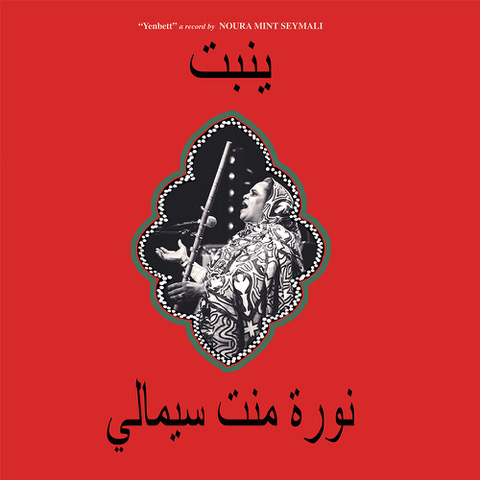
 Noura Mint Seymali’s third album and her first in nine years is a highly focused and impressive blast of desert psych. ‘Yenbett’ is a successful blending of tradition with innovation. A Mauritanian griot, Seymali comes from a significant musical family: her father, Seymali Ould Ahmed Vall, was a renowned composer and scholar; and her stepmother, Dimi Mint Abba, was a major singer and performer. Seymali is a practising griot – equal parts poet, singer, musician, historian and cultural custodian – a role that involves serving as a mirror to society and acting as artist celebrants at traditional weddings and ceremonies. She is also a virtuoso player of the ardine, a harp-like instrument similar to the kora that is unique to Mauritania and is only played by women. In another demonstration of her remarkable family lineage, her grandmother was pictured on the Mauritanian currency playing the ardine and taught Seymali how to play the instrument.
One of the remarkable aspects of ‘Yenbett’ is how seamlessly it mixes traditional elements with electric instruments in a way that ought not to work. Her husband, Jeich Ould Chighaly, conjures a fiery electric guitar sound and a fierce rhythm section gives the record a punishing momentum that could easily have overwhelmed the ardine. Drummer, Matthew Minari, co-produces the album, together with Mikey Coltun, best known as bassist with Tuareg desert rock band, Mdou Moctar, who serve as a useful reference point for listeners new to Seymali.
The album comprises 15 tracks, albeit seven of those are shorter linking, introductory pieces to fuller songs which serve to build mood and flow. ‘Lehjibb’, the first full track gives a flavour of the record’s qualities. The devotional style of Seymali’s ululating vocals is distinct to Islamic culture but in their emotive and powerful quality have much in common with gospel and soul. Blending with guitars and ardine, it creates a circular, repetitive and mesmerising sound while the translated version of the lyrics shows off the griot’s facilities. A love song that reflects her skill in reflecting tradition, it has references to tribal structures as an elder from the Medlish tribe flirts with a girl from the La’leb clan and a poetic quality as it describes Seymali singing “with strength and grace… with a sweetness that stings the soul” and an epigrammatic nature with its mention of a secret “like the shell that hides the turtle.”
The album’s first single ‘Guéreh’ is the one standalone piece without a linking track. A wedding dance song originally popularised by Jeich Ould Abba, a blind tidmit (Moorish lute) player. It reflects Seymali’s respect for tradition, unearthing a gem from Mauritanian history that had been long forgotten and presenting it with a fresh energy. Call and response vocals together with handclaps and bass drum give the song a ferocious, swirling, rhythmic quality, fitting with the lyrics which in translation reference strutting, swaggering and dancing. It is frenzied and trance inducing.
Minari and Coltun’s production captures both the band’s rawness and their percussive qualities especially well, ‘Knou’ being a particularly good example. The song starts slowly, drums echoing before ferocious guitar soloing takes over. The solo has a rare grit and verve and does not outstay its welcome. Those drums boom emphatically through ‘Tassirit’, a song that has Seymali’s voice soaring and beseeching as she illustrates struggle, long journeys and the narrator’s willingness to accept insults, complaints and to soothe.
‘Ch’tib (Naha)’ taps into the energy found under Moorish khaima tents during all-night festivities in the Sahara. Male griot vocalist, El Abghari Chighaly, brings his deeper tones and, along with backing vocals from Ayniyana Chighaly and Loubaba N’Guidheye, helps create a propulsive call and response. In its supplication, there is a fierce urgency that makes it one of the record’s highlights.
‘Hagala Geyeul’ sprinkles some 1970s disco synth percussion on its mighty drumming. The lyrics are also fascinating both for their lyrical poetry (“Oh you, who resemble Dimi in grace / like a gazelle in the golden dust”) but also for cherishing qualities that have not been prized enough in Western pop songs (“My new beloved is a kind man / With him, joy arrived and boredom fled.”)
As the emotive and powerful ‘Lebleida’ brings ‘Yenbett’ to its close, there is a heft and poetry to Seymali’s performance. The band throughout display an urgency, building momentum through repetition and progressing a theme, while the production has great clarity. It has emphatically been worth the nine-year wait.
Noura Mint Seymali: Yenbett – Out 7 November 2025 (Glitterbeat)

I was editor of the long-running fanzine, Plane Truth, and have subsequently written for a number of publications. While the zine was known for championing the most angular independent sounds, performing in recent years with a community samba percussion band helped to broaden my tastes so that in 2021 I am far more likely to be celebrating an eclectic mix of sounds and enthusing about Made Kuti, Anthony Joseph, Little Simz and the Soul Jazz Cuban compilations as well as Pom Poko and Richard Dawson.