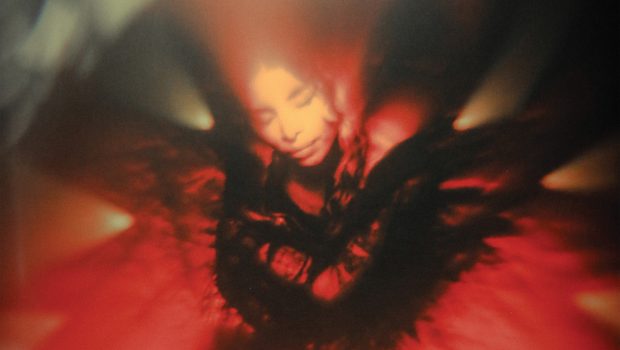
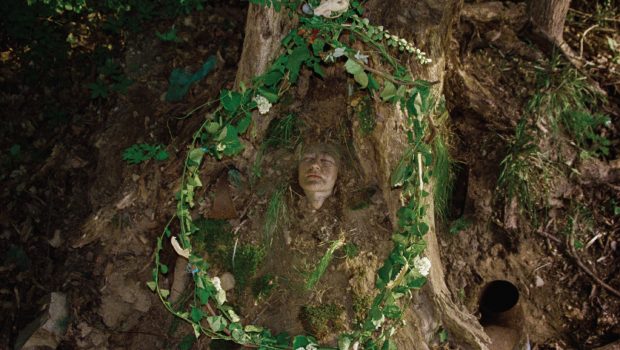
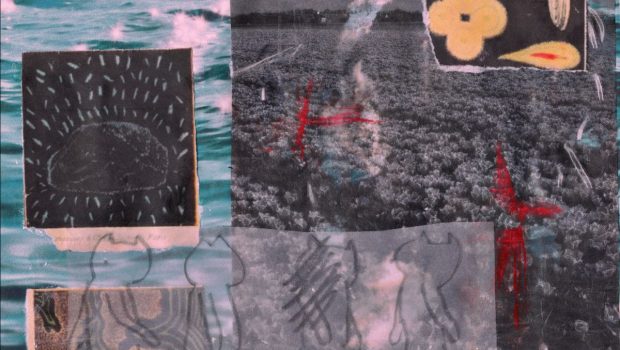
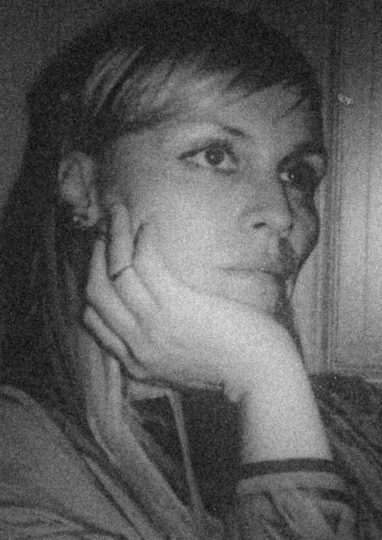
 Following two densely atmospheric instrumental albums, her latest record sees Hilary Woods making a welcome return to a song-based structure and giving primacy to her voice. ‘Night CRIÚ’ takes as its stated influences Czech and early Italian cinema, processions and parades, early music, indigenous language, the joy in dance, the immediacy of sound and the collective standing up to tyranny and oppression. As an esoteric set of influences, it indicates that this is still an album with a leftfield, adventurous heart.
What quickly becomes apparent is the importance of voice to ‘Night CRIÚ’ both as an actual sound but also as a concept; a lyrical theme about the difficulty of finding words as a means of expression runs through the record. A cello drone leads opening track ‘Voce’, creating a tension that is amplified by crawling percussion with the occasional bang and shriek of a violin. Woods’ voice is layered repeating the five-minute song’s only words, “I can’t hear your voice / dunno what it feels like.” It is an instance of repetition reflecting a dawning realisation and then insistence as the song concludes with a children’s choir which adds an emotional yet creepy element to the track.
The theme of locating a voice recurs in ‘Faults’ as Woods’ vocals, slow and precise reveal, “I could not form into words these things / I could not find ways to make them seen.” Its chorus has a hymnal quality to its plea, “take me lord oh as I am”, while the arrival of the Hangleton Brass Band increases its religious fervour. The inclusion of what sounds like a recorder makes its ending quite nerve shredding.
That tussle between language and feeling is reflected in ‘Endgame’ with the acknowledgement that “some talk some bring deep / but with words I can’t speak / silence holds me in you.” In its exhortation to “throw me down to the wolves” it has the essence of the darkest fairy tale, Woods’ tones sweet but sinister while the strings create a restrained cauldron.
Conflict is at the heart of ‘Brightly’. Woods sounds soothing as she counsels, “words that wound are never worth their fighting” and urges “forever go brightly my one” which has a sense of farewell. Much of its language with words such as ashes, embers and flames suggest something destructive and the strings rumble in a manner that captures this discord. Woods’ voice is virtually somnambulant on ‘Taper’, the brass band are subdued but the children’s choir that takes over the final chorus, their voices tilting and unnervingly high bring light to its shade.
‘Offerings’ is even more unsettling with its indistinct field recordings and background murmur set against drones and even the choir’s hum is a jumble of sounds rather than recognisable words. The record’s seventh and concluding track, ‘Shelter’ sees Woods half speaking, half singing, initially with a drone before strings create discombobulated drama, echoing the struggles of making it “thru impending falls / in the eye of any storm an anchor / how one learns to stand and ask.”
In reviewing Woods’ previous album, ‘Acts of Light’, for this website, Levi Mulholland highlighted the sensory nature of the music and even though ‘Night CRIÚ’ is a different and more accessible record in many ways, it retains that physical quality in abundance. It is an album whose sounds are almost possible to feel and touch, half an hour that is quietly overwhelming.
Hilary Woods: Night CRIÚ – Out 31 October 2025 (Sacred Bones)
Woods – Endgames (Official Video)

I was editor of the long-running fanzine, Plane Truth, and have subsequently written for a number of publications. While the zine was known for championing the most angular independent sounds, performing in recent years with a community samba percussion band helped to broaden my tastes so that in 2021 I am far more likely to be celebrating an eclectic mix of sounds and enthusing about Made Kuti, Anthony Joseph, Little Simz and the Soul Jazz Cuban compilations as well as Pom Poko and Richard Dawson.