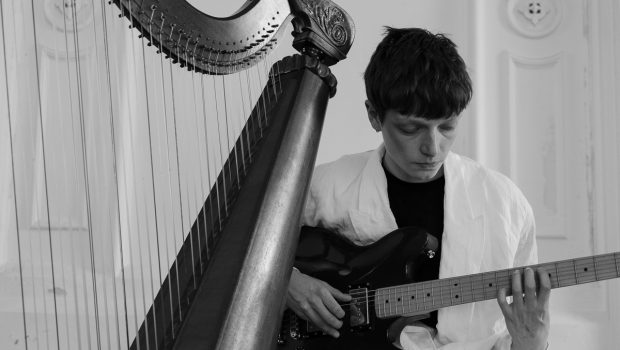
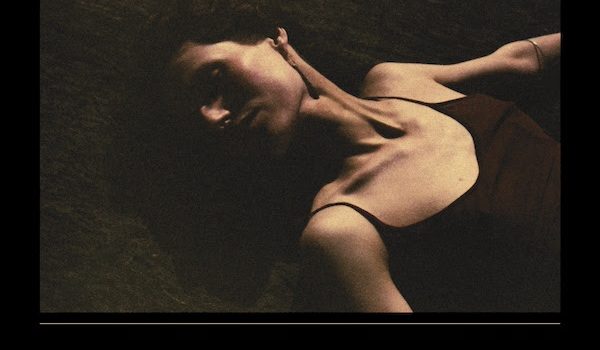
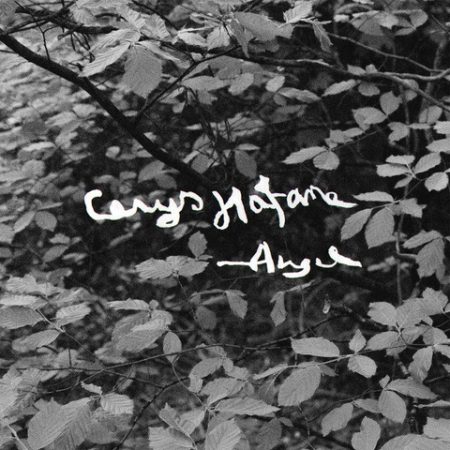
 Sometimes artists kindly try to do journalist’s work by describing their music. On Cerys Hafana’s Instagram page, their music is described as “sad Welsh harp pop”. As a description, this barely scratches the surface of what can be heard on their latest album, ‘Angel’. Whilst they indisputably sing in Welsh and play the triple harp, their music is only pop in the loosest sense and takes in elements of traditional, avant-folk and minimalism as well as a sizeable serving of other-worldly magic. Although it is as far from a collection of frenetically upbeat club anthems as it possible to imagine, it travels beyond self-pity to convey a wide range of emotions.
On much of the album, Hafana is accompanied by a trio of musicians: Ursula Harrison (double bass), Amie Huckstep (alto saxophone) and Lisa Martin (drums). Their contributions add considerable texture and sparkle to the release. Of the record’s nine tracks, five are instrumentals. Its opening song, ‘Helynt Ryfeddol’ which translates as ‘An Incredible Ordeal’, gives an indication of the album’s experimental heart. Hafana dampens the harp strings with Blu Tack to obtain a muted sound and plays the instrument’s frame as a percussion instrument. The interplay between vocals and saxophone is a rough approximation of the Breton ‘kan ha diskan’ style where the singers alternate lines so that there is a continuous melody and rhythm for the audience to dance to. Its lyric is a fable of a religious man who goes for a walk and hears a bird singing. So pure is the bird’s music that he stops to listen for what seems to be a couple of hours but when he returns home, the house and garden is completely changed and the strangers who are now living there claim no knowledge of him. The title track, which appears eighth on the running order, recounts a similar tale of an old man leaving his house and hearing joyful music. 350 years passed while he was listening by which time he had turned to ash. The interplay between Hafana and her trio as they weave their patterns is a magical mirroring of the storyline.
With its unaccompanied vocal sections, ‘Carol Mynyddog’ highlights the qualities of Hafana’s fragile but pure voice which tempers the harsher sound of the Welsh language. A call for spring to kill the snow with its cheerfulness and tune the harp that has been silent for so long, it fits the folk tradition of reflecting upon the seasons. Intrusions from sax and piano move from background colouring to dramatic bursts to create one of the album’s highlights.
Among the instrumentals, ‘O’r Coed’ (‘From the Trees’) has minimalist, repetitive piano playing with occasional deeper notes and some more classical style sprinkles while the saxophone adds considerable emotional depth, sometimes feeling like a bird. With sparse use of the double bass and drums, it feels richly contemplative. The harp playing on ‘Drexelius’ is also minimalist but has a quietly insistent rhythmic quality. As the record’s centre point and marginally lengthiest track at seven minutes, ‘An Dro’ (The Turn’) has rhythmic harp and sax that goes from initiating a jig to mournful and back again. In contrast, ‘Ffarwel i f’Ieuenctid’ (‘Farewell to my Youth’) has a muted harp take the spotlight, while ‘350 Mlynedd’ (‘350 Years’) displays greater range to the instrument and there are some lovely double bass notes and percussive shimmers.
‘Angel’ closes with ‘Atsain’ (‘Echo’), predominantly a drifting piano and sax instrumental, save for a barely audible pair of concluding vocal lines about leaving no more trace than of a ship that went over the waves or an arrow through thin air. Recorded live and over four days with minimal takes, it captures their fluidity and spontaneity so while the record is subtle and undemonstrative, it weaves its spell and is at its absolute peak when the instrumentalists combine at create a rare magic.
Cerys Hafana: Angel – Out 26 September 2025 (tak:til/ Glitterbeat)

I was editor of the long-running fanzine, Plane Truth, and have subsequently written for a number of publications. While the zine was known for championing the most angular independent sounds, performing in recent years with a community samba percussion band helped to broaden my tastes so that in 2021 I am far more likely to be celebrating an eclectic mix of sounds and enthusing about Made Kuti, Anthony Joseph, Little Simz and the Soul Jazz Cuban compilations as well as Pom Poko and Richard Dawson.