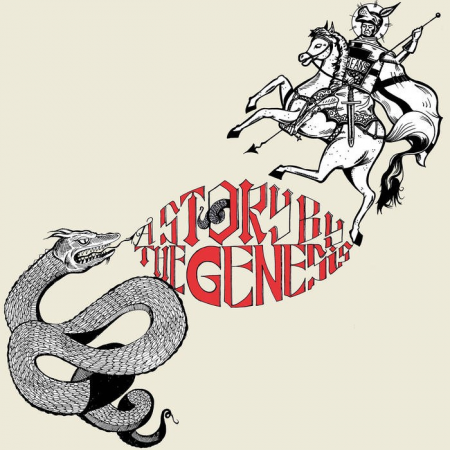
 Fear not! This is not an ode to Messrs Collins, Banks and Rutherford, or even Gabriel. The Genesis is an entirely separate beast and ‘A Story’ comes, aptly enough, with an incredible backstory. Hand of Glory Records’ Will Twynham (who records as Dimorphodons) was searching eBay for interesting instruments and came across an old Hohner Cembalet, painted matte black and with missing keys. The listing included a clip of a home recording which piqued Twynham’s interest further. Having won the auction with a princely bid of £10, he was delighted when the seller, Chris Stokes, offered to deliver the keyboard. Stokes mentioned that he had over 80 unheard tracks dating from 1964 to 1974 together with a complete unreleased rock opera from 1969 when his band were called Genesis. It is that concept album that appears for the first time in 2025 with a definitive article added to the band’s original name to avoid confusion with and litigation from the more famous band who later chose that moniker.
Rock operas were a new idea at the time. The Pretty Things had just released ‘SF Sorrow’ and The Who had publicly discussed ‘Tommy’ but were yet to release it. Being recorded over one session in January 1969, ‘A Story’ is far from polished in its production, any excess coming from its ideas and imagination rather than the grandiosity of the prog era. A glimpse at the songtitles on ‘A Story’ gives a clear indication of the album’s narrative direction, quickly passing through ‘Nightmares & Lazy Teenager’, ‘Happy Man’ and ‘Marriage’ before descending into ‘Hate’, ‘Murder’, ‘The Trial’ and ‘Death’, those titles acting like chapter headings.
What becomes apparent from opening track, ‘Reflections’, is the importance of Stokes’ keys to their sound. As the lyrics hark back to youthful summertime fairgrounds, those keys produce a warped take on circus big top music. The vocals shared between Stokes and guitarist Derek ‘Jock’ Carleton have some rough and ready harmonies while the rhythm section heads off in a jazzy direction. At nearly seven minutes in length, ‘Nightmares & Lazy Teenager’ is the longest track and starts with a beguiling and laidback melody even while setting out chilling dreams of alligators and serpents that have a lysergic vividness (“Then Saint George the dragon killer comes to rescue you with an orange peeler and dressed up in a baked bean can.”) Its musical shifts reflect the nightmarish tension. The opening bars of ‘Happy Man’ bear a resemblance to The Kinks’ ‘Sunny Afternoon’ but even when the songs are at their happiest, there is a compelling awkwardness and weirdness to their approach that recalls early-Bee Gees. Even ‘Marriage’, a celebration of the wedding day sounds slightly sinister with its keyboard washes and pulsing rhythms.
The opening stabbing bars of ‘Hate’ immediately suggest events taking a dark turn, a tale of paralytic drinking and loathing ensuing, ending with the menacing repetition of “I’m going to kill you.” ‘Murder’ has some appropriately ominous chords, occasional instructions to “kill” before conveying a sense of collapsing into absolute madness. ‘The Trial’ comes in two parts, the first ends with the proclamation “guilty” while the second begins with plans for building an electric chair as the music moves from beat group blues to psychedelia.
These constant musical changes to mirror the moods are one of the album’s great charms. ‘The Last Night’ has the narrator seeing the priest and requesting to see the sky for one final time. Even though he can see crowds gathering to watch, it almost has a philosophical ease. In contrast, ‘Death’ is hurried in its vocal delivery and ceaseless music, hurtling towards its final revelation, “Realisation in my brain / Life in a breath / These are your last thoughts / just before death.” Aptly, the song ends immediately. ‘L.O.V.E’ (standing for Life Of Varying Eternity) acts as a coda, a bucolic but melancholic celebration of nature.
Undoubtedly, ‘A Story’ is a curio, its origin story even appearing as a brief cameo on ITN’s News at Ten, offering light relief from its modern-day parade of tyrants. However, it is much more than just an oddball offering. While it is of its time in its ambition, the album has much to distinguish itself from music of the late 1960s. It is much darker than the flower power ideals of the era, influenced by post-war British boys comics rather than the classics. Musically, it avoids the commonplace heavy guitars, fuzz, phasers, Marshall stacks and Mellotrons, creating an ambitious work of ambition tells its tale through its musical shifts as well as its lyrics. Abandoning the conventional verse-chorus approach in favour of storytelling, even when the words are occasionally indistinguishable the music evocatively fills the void to tell the story. Due to Hand of Glory’s valuable excavation, the sound of a group from Luton inadvertently creating prog rock can finally be heard 56 years on.
The Genesis: A Story – Out 19 September 2025 (Hand of Glory)
Genesis (1969) – Nightmares (Radio Edit). From the previously unknown album “A Story”.

I was editor of the long-running fanzine, Plane Truth, and have subsequently written for a number of publications. While the zine was known for championing the most angular independent sounds, performing in recent years with a community samba percussion band helped to broaden my tastes so that in 2021 I am far more likely to be celebrating an eclectic mix of sounds and enthusing about Made Kuti, Anthony Joseph, Little Simz and the Soul Jazz Cuban compilations as well as Pom Poko and Richard Dawson.