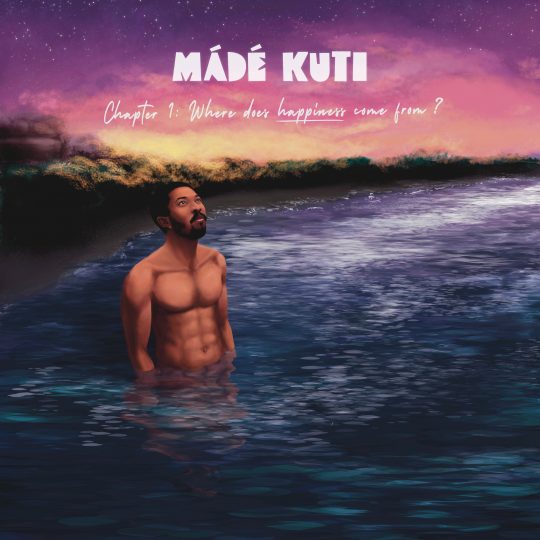
 It would be fair to call the Kutis the first family of Afrobeats. Fela Kuti developed and popularised the form, becoming such a powerful performer and spokesperson against corruption that he was frequently imprisoned by Nigerian leaders hellbent on silencing him. His sons, Seun and Femi, have continued in the tradition and now Femi’s son, Mádé Kuti, is adding his own chapters. Being part of such a well-known musical dynasty has its pros and cons. While it undoubtedly makes it easier to initially gain attention and get music released, there are high standards with which to be compared and potential accusations of being a nepo baby. Mádé’s debut album, 2021’s ‘Fore(ward)’, both tempted such sleights by being a shared release with Femi’s ‘Stop The Hate’ as part of the ‘Legacy +’ double album but silenced them by outshining his father. With his first standalone album, the aptly named ‘Chapter 1: Where Does Happiness Come From?’, he firmly establishes his own distinct footprint.
The album clearly represents Mádé’s vision as he writes and co-produces all 13 tracks, as well as providing lead vocals and usually lead trumpet on them. True to the Afrobeats template, he is accompanied by a substantial cast including various other trumpeters and saxophonists, keyboards, guitar, bass, polyrhythmic drumming and up to eight backing vocalists on some of the tracks. However, it also sees traces of other influences, particularly jazz, and reflects compositional techniques he learnt at London’s Trinity Laban Conservatoire of Music and Dance. In effect, he enjoys the best of both worlds: formal training and learning from family greats.
Opening track, ‘Take It All In Before The Lights Go Out’, sets out the musical agenda firmly with its intercom welcome to the Afrobeat express promising that “the trip is going to be wild AF / Unbuckle your seat belts.” With its buoyant horns blaring, keyboard runs and frantic percussive rhythms, it is easy to imagine it opening his shows and the audience instantly becoming a sweating mass of dancing bodies.
As would be expected from the Kuti family, the lyrics move far beyond the strictures to dance, looking both inwards and at the wider world. ‘Find My Way’ is an ode to learning from mistakes and benefits from the interplay between Mádé and his choir. There is huge energy to ‘You Can’t Hide’, a call to face your demons and not hide behind the church, propelled by its horn section and Emmanuel Idowi’s drums.
More frequently, he looks critically at the outside world and delivers sermons about the shortcomings of leaders. ‘Pray’ sees him launch into a broadside against sly, lying egotists, calling on them to confess to their crimes. ‘Won Na Pa’ reports that “savages kill / abusing lives of human bodies” while ‘Life As We Know It’ starts at a more musically relaxed pace while he asks reasonably, “How many cars do you need to drive from one place to another”, and then takes aim at multiple home ownership, ostentatious jewellery, drug-taking and drink driving. This could sound hectoring written down but it feels irresistible when it is accompanied by increasingly spirited horns and drums, together with the concluding positivity that “our greatness will come.” ‘Oya’ is coruscating in its critique of young black bodies dead due to government incompetence. On ‘My Voice’, he questions whether his vote counts, summarises the ballot as a choice between two different demons and selecting the lesser evil; while he is describing Nigeria, the analysis would chime throughout the world. The babble of voices and ferment of the horns serving to illustrate the conflict before the song climaxes in one of the wildest rhythms. Femi adds lead alto sax to ‘Story’ which reflects on the responsibility that comes with power and questions “are you better than the people you judge.” It is slower and more sprawling than most of the album but no less potent for it.
When Mádé expands his palette to incorporate wider musical influences into Afrobeats, the album hits its greatest heights. ‘Wait and See’ has a carnivalesque, calypso feel, the saxes swing and Victor Oduche’s piano has a classical sweep while the song namedrops his father’s tune, ‘Mind Your Own Business’, and reflects on trying to be content in one’s own skin. While his songs are considerably more concise than those of his grandfather who, to put it with mild understatement, was fond of a prolonged groove, the album’s lengthiest track, seven minutes of ‘I Won’t Run Away’ is a more relaxed jazz-tinged number, its emotion heightened by the addition of Nduka Austin Aliogo’s violin.
‘Where Does Happiness Come From?’ ends with ‘After The Tears Flow’, a fluent groove to send its audience dancing into the night. It concludes an album that is a decisive blend of uncompromising rhetoric and self-reflection with high spirited and inventive music. I will be avidly consuming this and future chapters.
Mádé Kuti – Chapter 1: Where Does Happiness Come From? – Out 25 July 2025 (Knitting Factory)

I was editor of the long-running fanzine, Plane Truth, and have subsequently written for a number of publications. While the zine was known for championing the most angular independent sounds, performing in recent years with a community samba percussion band helped to broaden my tastes so that in 2021 I am far more likely to be celebrating an eclectic mix of sounds and enthusing about Made Kuti, Anthony Joseph, Little Simz and the Soul Jazz Cuban compilations as well as Pom Poko and Richard Dawson.