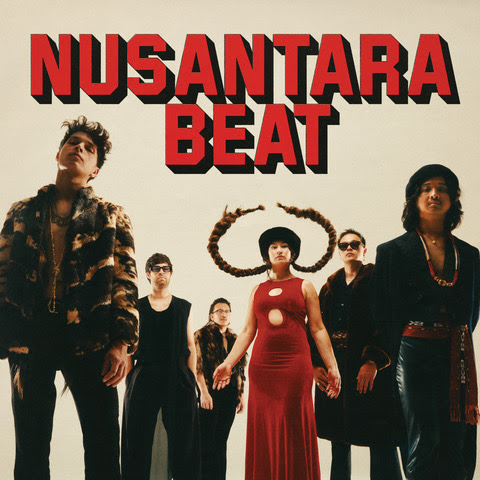
 While group names can often be random, Nusantara Beat has chosen one that encapsulates its ethos. Nusantara means all the islands that make up Indonesia and dates back to when kings wanted to unite the whole archipelago. Today, it means unity, many cultures coming together as one. Accordingly, Nusantara Beat mix the rhythms and music of the Indonesian archipelago into one sound.
The Dutch group are well-placed to explore these sounds on their self-titled debut. Bassist Michael Joshua was born in the Indonesian province of West Java and moved to the Netherlands aged 15 while the other five members are of Indonesian heritage. Their musical starting point is Sunda Pop, which in the 1960s blended traditional Sundanese music with contemporary pop, psychedelia, surf music and funk but they update it with modern production and synthesisers.
While their talk about the album focusing on the Sundanese musical tradition and the gamelan scale pelog sounds forbidding, they give pop a predominant place making it easily accessible for those firmly attuned to Western music. Consequently, although the use of traditional instruments such as the kecapi zither, kendang drums and Balinese gongs add to its distinctive flavour, the prime emphasis is upon guitars and synths. After beginning with layered voices, opening number ‘Ke Masa Lalu’ introduces the album’s guiding principle that its best tracks will have liberal doses of surf guitar. It is a love song with question marks at its heart, plenty of tempo shifts from its laidback verses with luxuriously light rhythms to the moments it totally catches fire when twangy guitars burst into the room bearing gifts.
While most of the lyrics are written in English by vocalist Megan de Klerk and translated into Indonesian by Joshua, the exception is ‘Kalangkang’ which was penned by Joshua and translated into Sundanese by guitarist / keyboardist Rouzy Portier. A tale of ghosts or doubts haunting the imagination, it is propelled by Jordy Sanger’s deliciously twangy guitar together with emphatic punctuation from drummer Sonny Groeneveld and percussionist Gino Groeneveld. It ends with a dramatic percussive snap and the courteous dialogue, “Sir, please walk me back home / Why miss, was there something stolen? / I think there’s a ghost.”
After this dramatic opening, the pace is relaxed on the smoothly soulful ‘Di Pantai’, its chilled keyboard melody and airy vocal matching its reflection on memory and aging, like a refreshing breeze as the participations eat fish by the seashore. The comfortable groove is maintained on ‘Bunga Mekar’, love firmly in the air (“Just like the flowers we bloom / You spread aromatic perfume”), little guitar flourishes giving it added sparkle.
The drama quotient is upped on the fantastic ‘Ular Ular’, which translates as ‘Snakes Snakes’. It combines dance beats, synths, male backing vocals and guitar fuzz with a sublime but slippery melody and a lyric that extracts maximum mileage from its metaphor of viperous love. Maintaining the title format of a repeating pair of words, ‘Kupu Kupu’ begins with a bassline that could be from a spy drama theme tune before letting its synths drift airily. While the song references “hands on the wheel”, it is actually the instrumental ‘Gapura’ that would make an excellent soundtrack to a car chase with surf guitar back to the fore, alongside rapid-fire bursts of Indonesian percussion. ‘Hilang Kendali’ makes the most of its contrasts between its silky vocals and synths and its twanging guitars while its lyrics capture an urge for freedom (“Drink up, and let go… This feeling of losing control.”)
‘Tamat’ was the first single previewing the album and it is easy to see why it was chosen. It is an instantly compelling, stirring piece of pop with whammy bar action, bongos and high-speed vocals which emphasise the expressive nature of the Indonesian language. In contrast, ‘Bakar’ builds from synth washes into a funky groove and develops a smouldering metaphor (“my lava can no longer be contained / It erupts, burning your heart”). As its momentum develops, guitars are the garnish that satisfyingly completes the song. Representing a distinct change of pace, closing track ‘Cinta Itu Menyakitkan’ starts and ends with gamelan sandwiching a piano ballad with De Klerk breathy and emoting in a tale how of “love’s disease / leads the heart.”
There are occasions on the slower ‘Di Pantai’ and ‘Kupu Kupu’ where the momentum dips but Nusantara Beat’s debut album is always quickly rescued by faster, more dramatic songs. Its best moments, of which there are plenty, are utterly intoxicating. It is a sound that sparkles and refreshes like pure water from the finest well.
Nusantara Beat: Nusantara Beat – Out 14 November 2025 (Glitterbeat)

I was editor of the long-running fanzine, Plane Truth, and have subsequently written for a number of publications. While the zine was known for championing the most angular independent sounds, performing in recent years with a community samba percussion band helped to broaden my tastes so that in 2021 I am far more likely to be celebrating an eclectic mix of sounds and enthusing about Made Kuti, Anthony Joseph, Little Simz and the Soul Jazz Cuban compilations as well as Pom Poko and Richard Dawson.