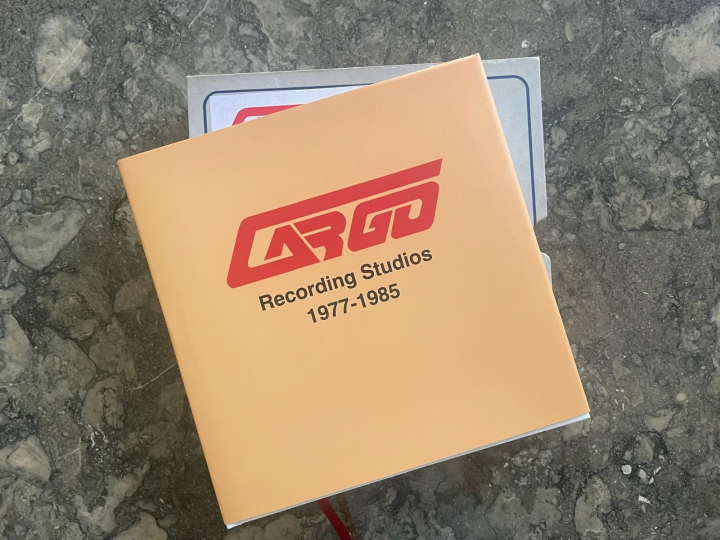
 For those with an interest in music from the punk era and its varied aftermath, Cargo Studios has legendary status. John Peel confided that he would often play a track, having not previously heard it, just because it said “recorded at Cargo” on the label. It started to gain its reputation when ‘Anthrax’ by the Gang of Four was recorded there and went on to be home to some groundbreaking recordings, Joy Division’s ‘Atmosphere’ being probably the most celebrated. Being based in a terraced, corner shop location in Rochdale, a north-west town best known for Gracie Fields and a football club invariably struggling in the lower reaches of what was then Division Four, added to its mythical status. However, there will have been practical benefits to its location outside its more glamorous neighbouring city of Manchester – property and rents will have been cheaper meaning that the rates they could charge for recording time (included a cheaper rate for overnight sessions) were more affordable to new independent bands.
Chris Connelly’s book celebrates the studio’s eight years. It acts as a scrapbook containing details and recollections of hundreds of acts that had formative recording experiences in this backstreet location. The book lists the bands in alphabetical order and is intended for intermittent reading, dipping in and out rather than reading chronologically like a novel or biography. Aptly, it is book in which the bands rather than the author take centre stage as the recollections indicate that studio owner and engineer John Brierley was a helpful figure who enabled bands to best capture their own sound rather than being consumed with developing his own reputation.
The esteem in which Brierley is still held can be illustrated by the guests at the book launch which saw a Q&A chaired by Clint Boon (Inspiral Carpets) and featuring the author, plus Peter Hook (Joy Division / New Order), Andy McCluskey (Orchestral Manoeuvres in the Dark) and Martin Moscrop (A Certain Ratio). With plenty of stories about the studio, plus working with Martin Hammett and Tony Wilson, their chat could easily form the basis for a very entertaining Evening With type tour or a podcast series. What was especially striking was how during those years music offered an accessible outlet for working class kids in the regions who not thrived at school. It contrasts with the current era where the music industry has become more London-centric and difficult to navigate for those without major label or parental support.
In addition to these artists, a dip into the book could bring reminiscences from other storied names such as Dead or Alive, Echo and the Bunnymen, The Fall and The Chameleons but it is as likely to focus on long-forgotten or never known acts including Basczak, Nyam-Nyam and Zyklon B. It unearths some unexpected beginnings: David Gedge’s first pre-Wedding Present demos were at Cargo with Mitosis, and his fellow band member Tim Duncan is now musical director for Disney on Ice; and Lisa Stansfield’s initial recordings were there as part of Oulder Hill Community School.
Mention should be made of the book’s packaging. The hardbacked book is contained in an outer case designed to look like a magnetic tape container but which is decorated with a photo of the studio’s interior. It is a hefty package that would be inadvisable to drop on your foot. The book itself has a plethora of photos, copies of fliers and original letters, a diagram of the studio layout as well as pictures of singles sleeves. John Robb recalls those sleeves decorating the studio walls and compares it to the ‘Welcome to Anfield’ sign in the tunnel at Liverpool Football Club. There is also a map and a list of distances travelled to record at the studio. While most of the acts were from northern England, some came from Bristol, London, Edinburgh and Glasgow but the prize for longest distance travelled goes to DAF who came the 575 miles from Dusseldorf, surely the greatest indication of the studio’s reputation.
After developing tinnitus, Brierley closed Cargo in 1985 but it remained a music studio called Suite 16, initially owned by Hook. It closed in 2000 and operated as a warehouse until 2013 when it returned to its original purpose as Voltalab Sound Studios. As part of Rochdale Music Stories, a compilation album of Rochdale artists covering songs previously recorded in the studio is to be released.
If there is one quibble with the book, it is that it would have benefited from employing a decent proof-reader but this is probably more of a bugbear to someone who spends their time editing a website than it might be to most readers. It is, though, a fascinating account of a studio’s role in one of music’s most productive and creative periods.

I was editor of the long-running fanzine, Plane Truth, and have subsequently written for a number of publications. While the zine was known for championing the most angular independent sounds, performing in recent years with a community samba percussion band helped to broaden my tastes so that in 2021 I am far more likely to be celebrating an eclectic mix of sounds and enthusing about Made Kuti, Anthony Joseph, Little Simz and the Soul Jazz Cuban compilations as well as Pom Poko and Richard Dawson.