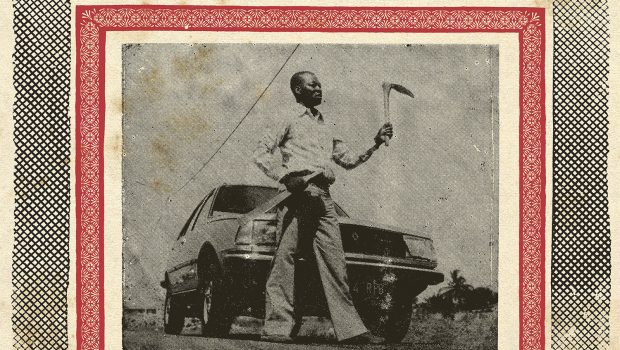
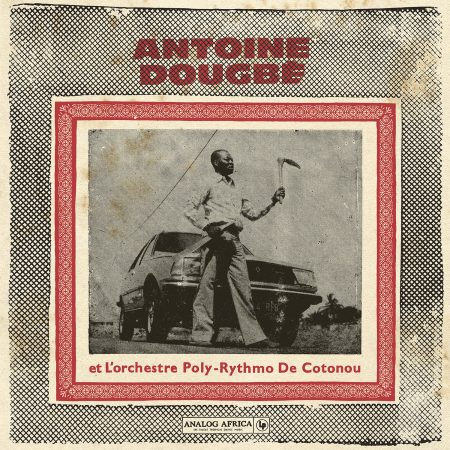
 Calling himself ‘The Devil’s Prime Minister”, Antoine Dougbe had a fearsome reputation. The son of a Vodún priest, he was initiated into the religion which while it acknowledges the existence of a single creator is more concerned with minor deities (the Vodúns) who live in the spirit world. This includes figures known as kovitos, spirits of ancestors who have temporarily returned to the human world. They are celebrated in rituals involving fearsome rhythms played on the ogbon (a talking drum), frenzied singing and costume dances. It was an early encounter with these ceremonies that inspired Dougbe to take up music.
He moved to Cotonou which in the 1970s was a centre of the West African music scene and was inspired by Cavacha, a rhythm devised by Zaiko Langa-Langa drummer Belobi Meridjo imitating the rhythm of a train carriage on its journey along the tracks. Dougbe dubbed his music as “Afro-Cavacha” or “Cavacha Pop” but it also blended in the traditional rhythms of Benin to create its own sound. Additionally, he had a unique composition method. Whereas most musicians picked out the music for their songs on guitar, Dougbe would sit outside singing and accompany himself by slapping out complex rhythms on his legs. Although these songs were not written down, he had an ally in Orchestra Poly-Rythmo De Cotonou’s bandleader, Mélomé Clément, who was instrumental in bringing his music to the world. While early in his career, Dougbe was known to threaten and intimidate musicians who did not play to his liking (the descriptions make Don van Vliet and Mark E Smith sound timid band leaders in comparison), Poly-Rythmo’s bassist and drummer were both deeply involved in Vodún so he did not dare challenge them.
Dougbe was more of a songwriter and producer than a traditional performer as he did not play any of the main instrumental parts and most of the vocals were handled by Lohento Eskill and Amoussou William. The twelve tracks that comprise this double album are taken from the three LPs and various singles that he released between 1977 and 1982, and it is not fear of his posthumous wrath that leads me to describe them as astonishing. Opening track, ‘We Tayi Sin Assi Tche’, provides a good introduction to what to expect over its extended grooves, most of the tracks being at least six minutes long. Call and response vocals, joyous guitar action, horns and keys all combine with Cavacha and Cuban rhythms to create an infectious and madly danceable number that ends with an emphatic horn blast.
Each track sizzles with energy and rhythmic dynamism. Some are more traditionally African in sound such as ‘Ze Nou Mi” which is propelled by bright guitars bolstered by occasional appearances from the horn section. The rawness of the vocals and zippy guitars gives ‘Djomido Ma Dougbe Tche’ a particular edge. In contrast, ‘Gnin We A Na Mon’ is a joyous configuration of Cuban rhythms, keyboard wig outs and brass punctuation. From here, the pace hots up further with the swirling organ, triumphant horns and super-fast vocals of ‘Ye Ko Gni Me Towe Dea’. There is something incredibly charismatic about the way the vocalist begins ‘Adin Gban Non Chouwe’ with an “ah, ha”, an especially attention grabbing introduction to what is a relatively soft-shoe rhythm on which the organ creates some flamboyant splashes before the horns have their trademark dramatic ending.
The band are expert at little flourishes that keep listeners on their toes. The organ introduction to ‘Vile De Nan Gni Noude’ being a prime example which sets up some devilishly busy, intersecting guitar lines while the percussion section thoroughly lives up to the Poly-Rythmo part of their name. It would be difficult to hear the opening competing parts of ‘Mon Non Doto Nagbe Leo’ without bursting into the biggest smile. After blasting off with the sharpest horns and organ peels, ‘Towe Nin’ gets down to some serious Cavacha train track rhythms. The hyper guitar and rhythms combination of ‘Ma Won Min Towe Leo’ makes for an emphatic and triumphant conclusion to the album.
This self-titled compilation from Antoine Dougbe et L’Orchestre Poly-Rythmo De Cotonou maintains its momentum throughout, never slackening its pace. It is a joyous combination of overlapping Afro-Cuban and Cavacha rhythms, guitars, keyboards and dynamic horns. Proof that on this occasion, the devil did have the best tunes.
Antoine Dougbe et L’Orchestre Poly-Rythmo De Cotonou: s/t – Out 17 April 2026 (Analog Africa)

I was editor of the long-running fanzine, Plane Truth, and have subsequently written for a number of publications. While the zine was known for championing the most angular independent sounds, performing in recent years with a community samba percussion band helped to broaden my tastes so that in 2021 I am far more likely to be celebrating an eclectic mix of sounds and enthusing about Made Kuti, Anthony Joseph, Little Simz and the Soul Jazz Cuban compilations as well as Pom Poko and Richard Dawson.