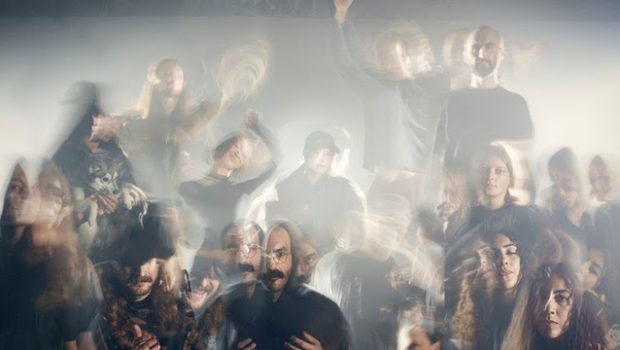
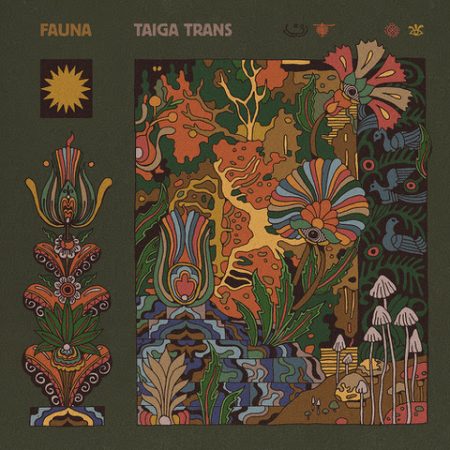
 Fauna’s debut album is a vivid and vibrant brew. An outernational combination based in Gothenburg in Sweden, they also have backgrounds from France, Finland, Syria, Poland and Turkey which feed into their sound. They utilise traditional instruments such as the darbuka (an ancient hand drum played across North Africa and the Middle East) and the saz (a long-necked lute used in Turkish folk) alongside instrumentation more regularly found in Western music. Because the conventions of musical genres are so firmly established, the main way of creating a sound that is fresh and original is to mix together different styles and this is something Fauna do expertly putting together elements of psychedelia, krautrock and rave in their tunes. It is a mix that has a kinship with Can and Goat but with a more propulsive dancefloor element.
A visit to a translation app will show that while the band name is Fauna, most of the album’s songtitles contain references to flora including trees, dunes and moss. However, while this might suggest something akin to an atmospheric nature documentary soundtrack, ‘Taiga Trans’ is filled with high-energy pieces. Even when sitting down to listen, it becomes hard to resist the temptation to indulge in head shaking, arm waving and feet moving. Although the album consists of eight tracks, they wash into each other without a break to produce a 43-minute continuous groove.
Its opener, ‘Bland stenar’ (Among Stones), begins with what sounds like the amplified noise of insects but quickly weaves intricate patterns through the saz and founding member Ibrahim Shabo’s booming bass. There is an element of mysticism to what might be treated human voices or instruments manipulated to seem like they are speaking a human language. It makes for a formidable start to the record. Following up, ‘En munfull sand’ (A Mouthful of Sand) opens with percussion reminiscent of the Burundi drums used so effectively by Adam and the Ants on ‘Ant Music’ before Fauna Buvat’s flute weaves beguiling shapes. The groove here is darker with the bass deeply embedded in the track before a Middle Eastern vibe develops.
‘Dunans torka’ (The Drought of the Dunes) is the one track with clearly defined vocals. Described as the soundtrack to a futuristic Syriac wedding, its chanted words translate as “cowardice has no place here, lest you deny yourself in dance”, exuding a sense of positivity. As the hand drums beat out irresistible rhythms, it wraps together with electronics, guitars and euphoric yells to create a party mood. “Bland träden” (Among Trees) begins with field recordings that suggest being out in a forest but the song quickly develops an insistent dance beat locked around psychedelic guitar figures before ending with a swathe of devotional singing. It is trance music in the purest sense of the word, although the hand drums again add variety and definition.
The only sub-three-minute track, ‘Boreala ändlösheten’ (The Boreal Infinity) is an atmospheric piece with brooding, menacing drums that offers a temporary break from the dancefloor before the techno leaning ‘Du ska få se’ (You Will See) raises the bpm to a new intensity. The combination of hand percussion with the more four-to-the floor electronic beats make for a polyrhythmic assault.
‘Taiga Trans’ ends with two of its three seven-minute-long pieces. ‘Frusen mossa’ (Frozen Moss) is especially mesmerising, a joyful combination of dancefloor repetition, twisting flutes, guitars and Middle Eastern textures before taking a dub turning. ‘Blodröda rubiner’ (Blood-red Rubies) serves as a textbook illustration of what they do so well, juxtaposing hands in the air rave exhilaration with psych guitar grooves and experimental, atmospheric turns.
On their debut album, Fauna creates a multilayered and multicoloured landscape that is occasionally disorienting and frequently joyful but always firmly alive.
Fauna: Taiga Trans – Out 10 April 2026 (Glitterbeat)

I was editor of the long-running fanzine, Plane Truth, and have subsequently written for a number of publications. While the zine was known for championing the most angular independent sounds, performing in recent years with a community samba percussion band helped to broaden my tastes so that in 2021 I am far more likely to be celebrating an eclectic mix of sounds and enthusing about Made Kuti, Anthony Joseph, Little Simz and the Soul Jazz Cuban compilations as well as Pom Poko and Richard Dawson.