 Anyone looking for a heart-warming documentary would be advised to watch the 2019 film ‘Keyboard Fantasies: The Beverly Glenn-Copeland Story’. It tells a remarkable life story incorporating becoming one of the first black students to attend McGill University in Montreal; releasing albums in the 1970s that mixed classical, spiritual, jazz and blues influences; writing for Sesame Street; and being a children’s entertainer on Canadian television as Mr Dressup. However, it was his 1986 electronic album, ‘Keyboard Fantasies’, recorded using only a Yamaha DX7 and a Roland TR-707 drum machine and released originally as a cassette-only 200-run that was long forgotten until rediscovered and promoted by Japanese record collector Ryoto Masuka in 2015, that sparked revived interest in his music. Reflecting in the documentary on his life and gender transition, Glenn-Copeland cuts a charming and sage figure enjoying life on the road with his significantly younger band who help him through the practicalities of touring while respecting a wise elder.
Presaging the release of ‘Laughter in Summer’, the news that he has been diagnosed with LATE dementia is devasting. While it could cast a bitter shadow over the record, it serves to emphasise his matter-of-fact approach to the inevitability of death as well as offering the opportunity to recognise the creative impact of his wife, Elizabeth, who plays a major role in shaping the album, alongside their musical director, Alex Samaras. The album takes its title from a song that arrived accidentally. Glenn began composing a series of instrumentals, intended to be called ‘Songs With No Names’, to which listeners would add their own words. Having played this piece to Elizabeth, she added lyrics and takes lead vocals on the track, an ode to their love (“love with each breath I take / here with you”) while Glenn and then the choir contribute wordless backing vocals.
The album uses his preferred technique of one-take recordings which enhances its sense of spontaneity. Many of the songs have a hymn-like quality consisting of economical but stirring words, backed only by Samaras on piano, while Glenn and Elizabeth’s voices are joined by a choir. It is a record that is dependent upon the quality of voices which thankfully are uniformly excellent. The album is bookended by Movements One and Two of ‘Let Us Dance’. Glenn’s voice is still strong and pure, a familiar vibrato in his delivery. A message of persistence and optimism is presented in its solitary verse where “the day greets the dawn / and the sun dances down beside / this road we are on” while the choir adds to the chorus’s purity. The theme of elements and seasons is maintained by ‘Ever New’ on which he greets spring, summer, rain and flowers. However, the lines that reflect his guiding philosophy are “welcome to you, both young and old / we are ever new” as his songs retain the capacity in old age to still view the world anew. There never seems to be any cynicism or bitterness within his songs, a rare quality for someone who has lived more than 80 years.
Throughout their lives, Glenn and Elizabeth found a shared vocation in art and community, especially for young people and a few songs reflect this outlook. Their voices combine well on ‘Children’s Anthem’, a song that was originally written for a teacher’s workshop on bullying and sounds like a modern-day secular hymn in its desire to “let them play and let them learn / and let them prosper day by day.” Naomi McCarroll-Butler’s whistle playing on ‘Middle Island Lament’ adds both musical variety and an evocative quality to a song which harks back to their time running a theatre school on the Acadian coast and takes in local history of famine, quarantine and farewell. That whistle reappears on ‘Prince Caspian’s Dream’ which quietly celebrates life, love, laughter and tears.
A piece originally written for Elizabeth’s birthday, the vocal arrangement on ‘Harbour’ is incredibly effective as first Glenn then Elizabeth sing the complete lyrics, before they join together on the chorus, the repetition serving to emphasise their steadfast unity and devotion to each other. The only cover, the traditional song ‘Shenandoah’ is a deeply affecting spiritual with no instrumental accompaniment, full of yearning (“I long to see you / Away, we’re bound away / cross the wide Missouri.”)
What is striking listening to ‘Laughter In Summer’ is the sense of perspective, no wallowing in self-pity and an acceptance of death as an inherent part of life, a position helped by fifty years of Buddhist practice. There is a rare selfless generosity of spirit to the words, a revolutionary kindness that should be an essential part of navigating an increasingly unjust and strife-riven world. As what could possibly be Beverly Glenn-Copeland’s final public musical offering, this album is a fitting addition to his unique legacy.
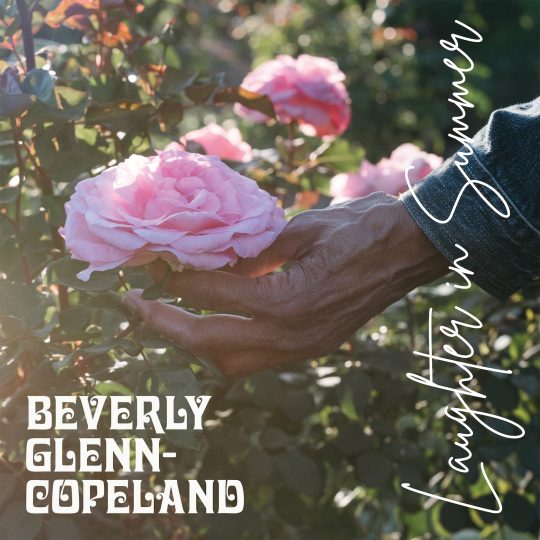
Beverly Glenn-Copeland: Laughter In Summer – Out 6 February 2026 (Transgressive Records)
Beverly Glenn-Copeland can next be seen in the UK performing at LIDO Festival supporting CMAT at Victoria Park on 12 June 2026.
Glenn-Copeland featuring Elizabeth Copeland – Laughter In Summer (Live at Hackney Empire)

I was editor of the long-running fanzine, Plane Truth, and have subsequently written for a number of publications. While the zine was known for championing the most angular independent sounds, performing in recent years with a community samba percussion band helped to broaden my tastes so that in 2021 I am far more likely to be celebrating an eclectic mix of sounds and enthusing about Made Kuti, Anthony Joseph, Little Simz and the Soul Jazz Cuban compilations as well as Pom Poko and Richard Dawson.