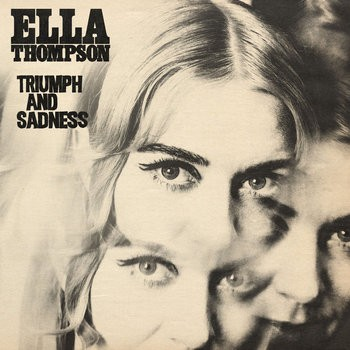
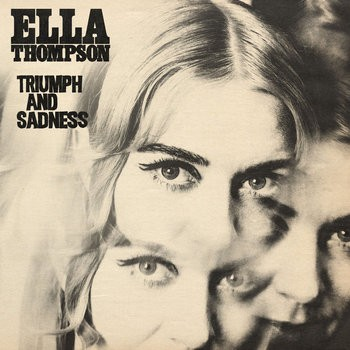
 When a voice can hit the highest of notes, it is transformative. Rather than being earthbound and inhibited, there is a sudden sense of release, a soaring sensation akin to being able to fly away from troubles. Ella Thompson is blessed with the sort of vocal range where she can effortlessly hit those upper notes in a Minnie Riperton-esque fashion and it is this quality that makes ‘Triumph and Sadness’ immediately notable. She is accompanied throughout by a classy style of vintage soul, reminiscent of the likes of The Delfonics but which also has touchstones in contemporaries who have found their home on Daptone Records such as Thee Sacred Souls.
Thompson hails from Naarm/Melbourne, not a place conventionally associated with soul music but she is inspired by a fellow Australian soul singer, Renée Geyer, who came to prominence in the 1970s. While taking influences from greats of the genre including Curtis Mayfield and Nina Simone, Thompson’s writing also leans on the philosophical approach of Patti Smith and Alice Walker in confronting life’s challenges.
‘Triumph and Sadness’ was recorded over four days in an all-analogue studio in rural Victoria with some follow-up sessions for horns, vocals and overdubs. On each track, she is joined by a double-figure cast who provide each song with a gentle but tactile soundtrack of Hammond organ and piano, trumpet, tenor saxophone, flute, harp, guitar, bass, drums, timpani and vibraphone, together with a five-person backing vocal section.
Opening track ‘Promise to Keep’, a song about embracing bravery and naivety in love, establishes a sound that will become familiar throughout the album. Propelled by a solid groove, interspersed with horn figures and a warm glow from the Hammond, bursts of call and response with the backing vocalists, Thompson’s voice soars for the first time on the line, “no more tears” and it would be difficult to remain unmoved.
With its timpani and horn introduction, ‘Parable’ begins boldly and maintains that momentum. Tom Pettit’s bass licks provide excellent punctuation, the backing vocalists coo and sashay enticingly while Thompson seeks to “learn from the parable / I’ll be the fool that believes / love will triumph”, a view that she sustains to the song’s conclusion.
While the songs are variations on a form, they invariably have details that make them stand out. On ‘Make You Believe’, Jethro Curtin’s Hammond glows, Thompson namechecks American nature poet Mary Oliver, sings particularly silkily before launching into a huge falsetto for the title line accompanied by urgent horns. ‘My Weakness’ is a slowish stormer, drawing on the myth of Narcissus to question the unsated longing of life under capitalism, it has that classic horn sound of vintage soul, an organ swirl and an especially simmering before letting go vocal.
Thompson changes the dynamic on ‘Time, It Won’t Forget’ introducing some spoken, almost whispered passages which gives the moments where she lets loose even greater power. Guitar and bass are more to the fore on ‘Beloved’, an up-tempo number where she eschews pretty things and superficialities in favour of love. In contract, ‘Change of Heart’ has a slower groove, reflections on impermanence and pleasing interplay between the horns, Hammond and the call and response between Thompson and her backing vocalists. The use of vibraphone gives ‘Dandelion’ extra spring and texture while she reflects on the difference between the flower’s beauty and its bitter taste, drawing parallels with the fear of caring too much in a relationship.
‘Triumph and Sadness’ is a concise album with all ten tracks being of approximately three-minutes length which is beneficial due to the similarities between the songs. Nine of them are composed by Thompson with Liam McGorry whose trumpet forms an excellent horn section with Cheryl Durongpisitkul’s tenor saxophone. The arrangements are invariably neat, in combination almost too tidy, and make the one tune on which Stuckey and Curtin are her co-composers, ‘Lover’s Game (In Love Again)’, a welcome slice of variety. Here, the song begins with the breathless flutter of Erica Tucceri’s flute and Siwei Wong’s harp, utilises some jazz-leaning rhythms and allows full reign for Thompson’s vocal expression as it fluently flits between tightly structured and looser arrangements.
As an entirety, ‘Triumph and Sadness’ is a collection of exquisitely constructed vintage soul that serves as a calling card for the talents of Thompson and her band. While not fully warranting being described as a triumph, it is a showcase for a vocal talent with so much potential.
Ella Thompson: Triumph and Sadness – Out 16 October 2026 (Mr Bongo)

I was editor of the long-running fanzine, Plane Truth, and have subsequently written for a number of publications. While the zine was known for championing the most angular independent sounds, performing in recent years with a community samba percussion band helped to broaden my tastes so that in 2021 I am far more likely to be celebrating an eclectic mix of sounds and enthusing about Made Kuti, Anthony Joseph, Little Simz and the Soul Jazz Cuban compilations as well as Pom Poko and Richard Dawson.