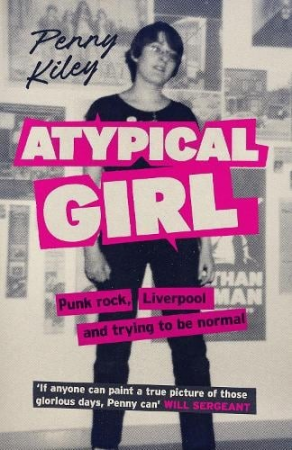
 The Liverpool punk and post-punk scene centring around legendary club Eric’s has been celebrated in a number of books. Performers whose names are indelibly linked with the venue have offered memorable recollections, starting with Julian Cope’s Head On and followed more recently by Will Sergeant’s Bunnyman and Paul Simpson’s Revolutionary Spirit. As a scene whose main participants were blessed with larger-than-life characters and excelled at providing good copy, it is unsurprising that these have been some of the best music autobiographies.
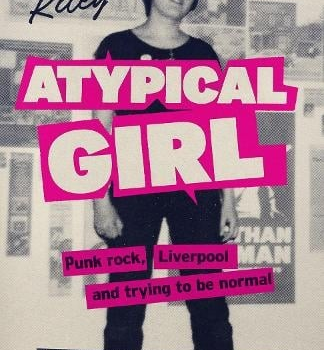
Penny Kiley’s memoir offers a fresh perspective. Coming from Sittingbourne in Kent to study at the University of Liverpool, she became immersed in the scene and provided live reviews for Melody Maker. With its twist on a Slits song title, Atypical Girl hints at various threads that run through the book. Entering the 1980s, which was when I was started reading the music press, there were very few women writing in its pages, mainly the contrary Julie Burchill at the New Musical Express and the boisterous, almost ladette prototype Carol Clerk at MM. Kiley’s writing stood out and not just because I was sold on the mystique of Liverpool the place. Whereas NME writers in particular were often quoting theorists who would only become familiar to me later when I took cultural studies courses at university, Kiley was a concise writer with a good turn of phrase. It is this writing style that makes Atypical Girl a joy to read. There are short, snappy chapters, sometimes with numbered points with titles like ‘How to look like a punk’ (to which the conclusion is more connected with not looking like postcard punk stereotypes) and ‘How to become a music journalist’ which includes the instruction Be Memorable, guidance that she heeds.
I was unfamiliar with Kiley’s other work beyond the pages of Melody Maker which included contributing to Smash Hits and becoming music correspondent for the Liverpool Echo. At The Echo, her struggles to fit in are apparent as she fights to maintain coverage of up-and-coming local bands, tries to resist subscribing to the paper’s desire for sensationalist, showbiz copy and the attempts to turn Liverpool into a Merseybeat heritage site.
Unlike most music memoirs, it covers life after involvement in the music business which is not necessarily a career for life. In this respect, it reminds me of Nige Tassell’s ‘Whatever Happened To The C86 Kids?’ in giving equal billing to life beyond the music world. There is much with which I can empathise. Not wishing to be old and embarrassing, she leaves music journalism before reaching 40. This was still a common outlook in the 1990s. I stopped writing a fanzine before turning 30 and never imagined that I would return to obsessive music fan journalism in my fifties. Kiley builds a new career in public sector office work, then moves to Didcot, Oxfordshire with her second husband to get away from being defined by what she used to do. She becomes depressed trying to negotiate office politics and finds herself shocked to find people whose outlook differs from the Liverpool ethos she still subscribes to of Never vote Tory, Never buy The Sun. She quotes Oxford born Roger Eagle, the driving force behind Eric’s, who described himself as a “southerner by birth, northerner by emotion”. Having been born in Hampshire but spent virtually all my life in the north, I can identify with that description.
Throughout Atypical Girl and in its subtitle, there have been hints at the struggle to appear normal. She speaks of punk as a turning point where it became acceptable not to fit in. During a chapter about attending Suggs’ wedding, she states, “People seemed to be having fun. I sat in a corner and watched. Like I always did.” Her twin sister dies and Kiley acknowledges her upset but whereas it might have been the centrepiece of many memoirs, it is brushed off in a few pages. There are problems whenever a change of plan is required. As a music journalist, she enjoys writing but has difficulties learning to speak to people. Later, experience teaches her that being opinionated on paper is good but bad when speaking to people.
This is finally addressed directly in a two-page afterword where she describes finally getting an autism diagnosis aged 60. She explains how her desire for wild abandon was never going to be possible when you fear everything. Like Kiley, I was brought up in a time where some people were just thought to be shy, socially anxious and have problems gauging the nuances of social interaction without there being an explanation of why that might be. To an extent, I would have liked the process of being diagnosed to have been covered in greater detail. However, in the same way that it is not really a How To guide, it is not a book solely about autism and there is a reading list for those who want to find out more about it. What Atypical Girl does offer, though, is an engaging memoir that centres upon her observations of one of the most vibrant music scenes and how in living a life that has not followed a predictable pattern, she has remained resolutely punk.
Penny Kiley – Atypical Girl: Punk rock, Liverpool and trying to be normal – Published 5 March 2026 (Polygon)

I was editor of the long-running fanzine, Plane Truth, and have subsequently written for a number of publications. While the zine was known for championing the most angular independent sounds, performing in recent years with a community samba percussion band helped to broaden my tastes so that in 2021 I am far more likely to be celebrating an eclectic mix of sounds and enthusing about Made Kuti, Anthony Joseph, Little Simz and the Soul Jazz Cuban compilations as well as Pom Poko and Richard Dawson.